





Table of Contents
In India, when the transaction of purchasing, selling, or transferring a piece of land, a building, or an apartment is done, it is not sufficient to just exchange money or make a deal verbally. It is necessary to have some documents to prove the owner’s rights over the property. Such legal documents are called property deeds.
The deed is basically a legal document that contains information about the conveyance of property rights from one party to another. It is usually in writing and contains details regarding the property and the parties involved in the transaction.
But most people become puzzled when it comes to technical words like Sale Deed, Conveyance Deed, Gift Deed, and Relinquishment Deed. This is because each kind of deed has a different use for different kinds of transactions. For instance, a Sale Deed is mostly made during the purchase of the property while a Gift Deed is made when transferring a property as a gift to someone, while Relinquishment Deed is made when a co-owner relinquishes his share from the property.
This article seeks to explain what is the meaning of property deeds, the different types of property deeds in India, their uses, and the key differences between them. We will also cover the registration process and important legal points to help you understand property documentation and make informed real estate decisions.
What Is a Property Deed in India?
The property deed meaning should be considered by taking into account the fact that it is the official proof and guide regarding real estate. In general terms, it can be defined as the written document that officially recognises the owner of the property.
While informal agreements can exist, a property deed has to be written on non-judicial stamp paper and has to be signed by all the parties to the deed and witnesses. Without a proper deed, it becomes extremely difficult to prove ownership in an Indian court of law.
Types of Property Deeds in India
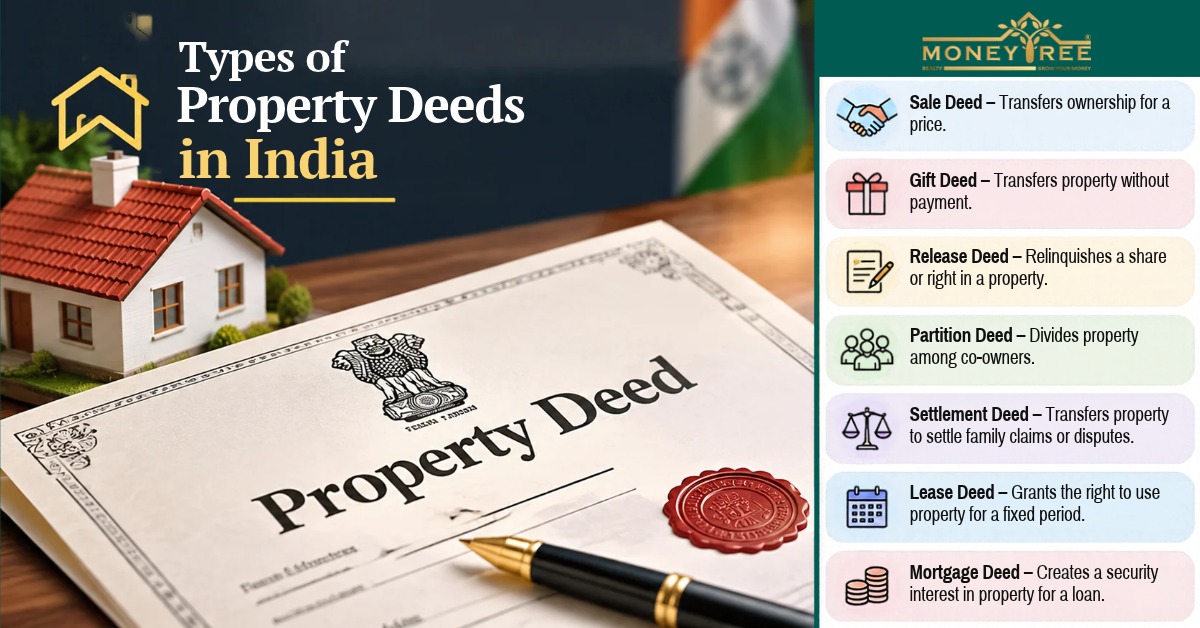
In India, various deeds are needed for different kinds of property transactions based on the reason behind the transfer of ownership of the property. Knowledge about the various kinds of property deeds in India is important when one is purchasing, selling, giving away, or transferring his or her property. Here, we will be discussing 11 main kinds of property deeds in detail along with their significance and terms and conditions.
Sale Deed
The Sale Deed is one of the most widely used instruments during the buying or selling of any property. It serves as an agreement between the vendor (seller) and vendee (buyer), under which the seller gives all his rights in respect of the property sold to the buyer for monetary consideration.
Off Deed
The off-plan deed is applicable when purchasing a piece of land which is not yet ready for use but exists only in the architectural drawings or when the land is still being constructed.
It does not involve any physical transfer, as this particular deed binds the buyer into a contract involving price, floor plan, payment terms, and delivery date. After the construction of the house and issuance of the Occupancy Certificate (OC), the Sale Deed is executed.
Gift Deed
When a person wants to transfer the ownership of his/her house or plot without receiving any money in exchange, a Gift Deed is the document that is used. It is commonly used when one transfers property to his/her child or any other family member. A Gift Deed, once accepted, cannot be easily withdrawn.
Lease Deed
In a Lease Deed, it entails an agreement whereby the owner of the property (Lessor) permits the other party (Lessee) access to and occupation of the land or property for a specific duration in exchange for rent. While short-term agreements such as those lasting less than 11 months may opt for a simple rent agreement, those above 12 months require a Lease Deed.
Mortgage Deed
When you get a mortgage from a bank for your house, you have to sign a Mortgage Deed, which gives the bank the legal right to possess your house as long as you don’t repay the loan. If you fail to make payments, then the bank has the right to sell your house.
Relinquishment Deed
It is sometimes called a Release Deed. This is applicable where there are several joint owners of a property, normally by inheritance, and one of them wishes to relinquish his ownership to the other joint owners. It may be executed either for something in exchange or without any money transaction at all.
Partition Deed
Whenever co-owners of any piece of land wish to split the land among themselves, they have to make a partition deed. Such deeds are frequently made by members of the family who wish to divide the ancestral property amongst themselves.
Exchange Deed
Instead of buying and selling property for cash, an Exchange Deed allows two individuals to exchange their properties. For instance, if an individual owns a flat in the city while another owns a piece of farmland outside the city with equal value, they can exchange them using the Exchange Deed.
Conveyance Deed
The conveyance deed is a generic term used for documents that transfer ownership of any property from one individual to another. A sale deed is used when property is sold in return for payment, but a conveyance deed covers sales, gifts, exchanges, and leases. Moreover, the conveyance deed is issued by the constructors to the housing societies after building on land.
Settlement Deed
The use of a Settlement Deed is most common within the family to allocate the assets between the heir or dependent while the owner is still alive without involving any monetary deal. As against a Will which becomes operative on death, a Settlement Deed becomes operative immediately.
Trust Deed
A Trust Deed is a document that transfers the ownership of the property to the trustee, who will manage the property on behalf of certain beneficiaries (like the minor child or charity). The trustee is the holder of the title deed, and the beneficiaries will benefit from the trust under terms of the document.
Key Differences Between Different Types of Property Deeds
Selecting an improper document will render your transaction null and void. When you analyse a sale deed vs a gift deed, for example, you will understand the difference made by the intention behind them. In a sale deed, there is an exchange of money along with the imposition of normal stamp duty, but in a gift deed, there is none.
| Deed Type | Money Involved? | Ownership Transferred? | Typical Use Case |
| Sale Deed | Yes | Yes (Permanent) | Buying a house, flat, or plot |
| Gift Deed | No | Yes (Permanent) | Gifting property to family or friends |
| Lease Deed | Yes (Rent) | No (Possession only) | Commercial spaces or long-term rentals |
| Mortgage Deed | Yes (Loan) | No (Security interest) | Taking a loan against property |
| Relinquishment Deed | Optional | Yes (Partial share) | Co-heir giving up inherited share |
| Partition Deed | No | Yes (Divided shares) | Splitting joint family property |
What essential information should a property deed contain?
For the deed of property to become legally valid and to prove the ownership of the property in India, there is a need for some basic information. These pieces of information will always differ based on the type of deed used, but in general terms, the property deed should have the following:
How to Register a Property Deed in India?
Under Section 17 of the Indian Registration Act, 1908, it is mandatory to register documents (deeds) related to the transfer of immovable property valued at ₹100 or more. Follow these steps for the property deed registration process:
Documents Required for Property Deed Registration
Before going to the Sub-Registrar's office for registration, all documents required for registration need to be prepared:
Difference Between a Property Deed and a Sale Agreement
Most people who purchase real estate for the first time often mistake an agreement to sell for a sale deed, but both serve entirely different functions.
Common Mistakes to Avoid While Executing a Property Deed
The execution of a property deed requires many legal formalities, and a slight error may cause future ownership problems, loss of money, or even legal hassles. It is imperative for you to check your papers thoroughly while buying, selling, or transferring any property. Below are some common errors one must avoid during the execution of a property deed in India:
How to Verify the Authenticity of a Property Deed?
Before buying any property in India, it is important to authenticate the documents of the seller’s property to check whether the ownership rights are legal and authentic or not.
This will help you save yourself from facing any problems in the future such as frauds and ownership disputes. Always make sure that you check the documents of the property before paying anything.
Conclusion
Having knowledge about the various types of property deeds in India will assist you in making the right decisions and help you steer clear of any legal hassles that might arise in your real estate transactions.
If you are preparing a Sale Deed for buying a flat, or a Gift Deed for transferring property within the family, or a Partition Deed for dividing the ancestral property, then choosing the right deed and registering it is extremely important.
One should always confirm the details of ownership, the legal status of the property, pay for any stamp duty and registration fees, and get the guidance of an experienced property attorney before signing a deed of a property. This will avoid many problems in the future.
In case you seek help in selecting the right property or verifying any information about the same, then contact us at MoneyTree Realty - India's Most Trusted Real Estate Advisor. We will assist you in choosing from the best properties around you. For expert property consultation, call +91-9732300007 today.
Frequently Asked Questions