



Table of Contents
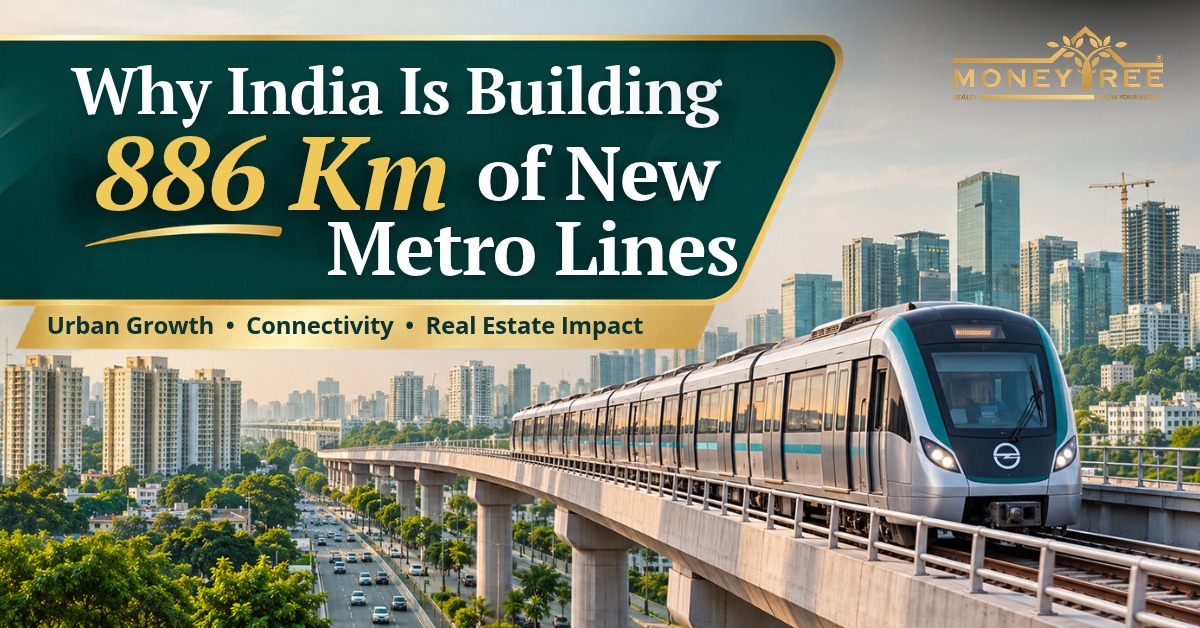
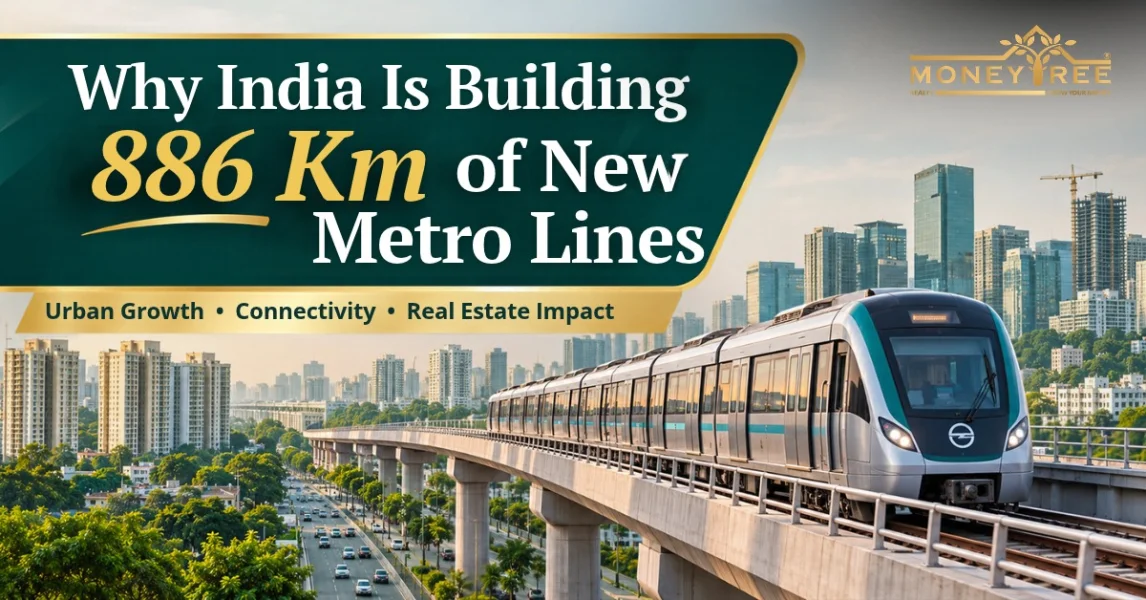
Indian cities are experiencing a universal problem, which includes increased congestion and commuting times. In response to this problem and the increasing population in urban areas, better public transportation systems have become a priority for the government. One way India is solving the problem of congestion is by developing its metro system, which consists of 886 kilometres of new metro lines across 30 corridors. In the Union Budget 2026-27, ₹30,942 crore was spent on metro projects.
The expansion process is not only focused on adding railway lines to the existing infrastructure. The goal here is to provide quick, affordable, convenient and eco-friendly transport to millions of people who are commuting on a day-to-day basis. As daily metro passenger figures touch 1.15 crore, the developing system improves connectivity in cities like Mumbai, Chennai, and Bangalore as well as extends metro service to upcoming urban centres like Surat, Kanpur, Patna, and Indore.
But why is India making such heavy investments in its metro network? What are the cities that would be served by these new metro lines? There are many reasons for the rapid expansion of metro systems in India. We shall now examine these reasons along with the ongoing projects.
Why Is India Building 886 km of New Metro Lines?
However, construction of underground tunnels and elevated viaducts is both a time-consuming process and needs investments of billions of rupees. Despite all that, central and state governments are actively implementing these 886-kilometre metro projects. There are four reasons for this venture:
Growing Urban Population and Traffic Congestion
Every year, countless people move to urban areas in India for employment and educational purposes. The majority of the roads in India are not designed to cater to the large number of vehicles, such as personal cars and bikes.
In cities like Bengaluru, Pune, and Delhi NCR, travelling even a distance of 15 kilometres during peak hours can easily exceed an hour. Just expanding the roads will not work; the only way out is to transfer commuters from road transport to the rail transport system.
Increasing Demand for Rapid Public Transport
Nowadays, people expect consistency. The bus service can be delayed, being stuck in the same traffic jam as all other cars, whereas app-based taxi services tend to be unreliable and costly.
The modern metro system works on its own tracks, being isolated from all road traffic. This means that one is guaranteed to reach their destination within a certain period of time, which is 25 minutes, for instance.
Economic Growth and Improved Urban Connectivity
Cities grow at a much faster pace when people are able to move around conveniently. This happens by linking the residential areas to IT parks, industries, airports, and railway stations, which helps firms have a wider pool of talent. In addition, people do not have to resign from their jobs just because they find their commute unbearable.
Sustainable Mobility and Pollution Reduction
However, air pollution still persists in North and Central India due to several reasons, among which vehicle emissions rank first. Electric metro trains carry thousands of people in each trip and do not produce any pollution at all.
It is relatively easy to encourage people to give up their gasoline- or diesel-run cars and move to electric trains in India.
886 Km of New Metro Lines in India: City-Wise Breakdown
The metro rail construction that is going on in India covers mega-metro areas and upcoming regional metros as well. The following is the list showing the breakdown of the network of 886 km.
Delhi-NCR Metro Expansion
The DMRC is working on an aggressive expansion plan for the Delhi-NCR Metro Phase IV to enhance connectivity in the capital city. This phase emphasises the connection between densely populated areas of North, East, West and South Delhi.
The following are the major metro expansions:
| Metro Corridor | Approx. Length | Key Areas Covered | Key Benefits |
| Janakpuri West – RK Ashram Marg | 29.26 km | Janakpuri, Peeragarhi, Mangolpuri, Ashok Vihar, Azadpur, RK Ashram | Better connectivity between West, North and Central Delhi |
| Majlis Park – Maujpur | 12.32 km | Burari, Jagatpur, Khajuri Khas, Bhajanpura, Maujpur | Improved connectivity across North and Northeast Delhi |
| Aerocity – Tughlakabad (Golden Line) | 23.62 km | Aerocity, Mahipalpur, Vasant Kunj, Mehrauli, Saket, Khanpur, Tughlakabad | Better airport connectivity and faster travel across South Delhi |
Note: The Janakpuri West-RK Ashram Marg corridor is an expansion of the existing Magenta Line corridor and not a totally new metro line. Once constructed, it will enable the Blue Line to gain another interchange point along with the existing interchange points at Botanical Garden and Janakpuri West.
Additional Metro Expansion Projects
In addition to these corridors, there are other expansion projects planned for Phase IV of Delhi Metro.
| Additional Corridor | Approx. Length | Expected Connectivity |
| Inderlok – Indraprastha | 12.38 km | Central and North Delhi |
| Lajpat Nagar – Saket G Block | 8.39 km | South Delhi |
| Rithala – Narela – Nathupur (Kundli) | 26.46 km | Outer North Delhi and NCR |
Noida Metro Expansion
The Aqua Line is receiving a long-awaited boost as it connects Greater Noida West (Noida Extension) to Sector 51 of Noida. Additionally, there will be connections for Knowledge Park V and enhanced interchange connections from Delhi’s Blue Line. These changes will benefit lakhs of commuters daily in the NCR region.
Project Highlights
The first segment from Janakpuri West to Krishna Park Extension was commissioned . The rest of the priority corridors are expected to be completed in stages by December 2026, as per the government’s project timeline.
Delhi Metro Rail
In all, Delhi Metro Phase IV is poised to revolutionise urban transportation in the Delhi NCR region.
Bengaluru Metro Expansion
Namma Metro is striving to reduce the infamous traffic jams that Bengaluru faces. Construction of the Pink line (Kalena Agrahara to Nagawara) and the Blue line from Central Silk Board to Kempegowda International Airport via KR Puram is going at a fast pace.
With these corridors up and running, movement from important tech zones to the airport will be easier than before.
Chennai Metro Phase 2
Chennai has embarked on one of the largest metro network expansions in a single phase in the nation. The second phase covers a distance of over 116 kilometers across three new lines from Madhavaram to SIPCOT, Lighthouse to Poonamallee Bypass and Madhavaram to Sholinganallur.
Pune Metro Expansion
Pune is gradually spreading out beyond its original operational corridors. The construction of the corridor between Hinjawadi and Shivajinagar (Line 3) is integrating the huge Rajiv Gandhi Infotech Park with the main area of Pune. Also, efforts toward the Pimpri-Chinchwad and Swargate-Katraj areas are enhancing north-south connectivity.
Jaipur Metro Phase 2
To decongest its most heavily travelled business district, Jaipur is planning to move ahead with Phase 2, which would go from Sitapura Industrial Area to Ambabari. The north-to-south route would connect several colleges, hospitals, airports, and bustling markets.
Lucknow Metro Phase 1B
After successfully establishing the North-South corridor, the plan is to establish the East-West corridor in Phase 1B. The East-West corridor, which will extend from Charbagh to Vasant Kunj, will facilitate rapid transit to Old Lucknow, which includes Aminabad and Chowk areas.
Kanpur and Agra Metro Projects
The industries and tourist destinations of Uttar Pradesh are developing rapidly. In Kanpur, construction work for the remaining underground portions of Corridor 1 (IIT Kanpur to Naubasta) and Corridor 2 (CSA University to Barra-8) is being carried out. On the other hand, in Agra, the expansion of the network is proceeding from the Taj Mahal corridor toward Sikandra and Agra Cantt.
Surat and Ahmedabad Metro Expansion
The two engines of Gujarat’s growth are developing aggressively. The Ahmedabad Metro Phase 2 is developing its network to Gandhinagar and GIFT City, thus providing financial sector workers with a seamless connection. At the same time, Surat is building two corridors through diamond and textile centres like Sarthana, Dream City, Bhesan, and Saroli.
Indore, Bhopal and Patna Metro Projects
Madhya Pradesh and Bihar have entered the metro age with great enthusiasm. While both Indore and Bhopal have surpassed the trial stage of their metro rail project on their important stretches, the process of construction for the rest of the elevated and underground tracks is taking place in their central city regions. Work in Patna on East-West and North-South corridors is joining Danapur, Patna Junction, and New ISBT.
Nagpur, Kochi and Thane Metro Projects
Tier-2 and satellite cities are fast catching up. The second phase of the Nagpur Metro is expanding into satellite industrial towns such as Butibori, Hingna, and Kanhan. The second phase of the Kochi Metro is extending its Pink Line to Kakkanad’s Infopark. Thane, on the other hand, is constructing an internal ring metro to link residential areas along Ghodbunder Road with Thane station.
City-Wise Comparison of New Metro Lines in India
| City / Region | Major Project(s) Under Construction | Total Upcoming Length (km) | Physical Progress / Status |
| Bengaluru | Phase 2, Phase 2A & 2B (Airport Line), Phase 3 | ~174.9 km | Phase 2 (~96% complete); Phase 2A/2B (~73%); Phase 3 in early stages |
| Chennai | Chennai Metro Phase 2 (3 Corridors) | ~118.9 km | ~55% physical progress |
| Delhi-NCR | Delhi Phase IV, Rithala–Kundli, Phase V(A), Gurugram Metro | ~136.2 km | Phase IV (~82% complete); Rithala–Kundli & Gurugram in early stages |
| Pune | Line 3 (Hinjawadi–Shivajinagar), Phase 1 Ext., Phase 2 & Line 4 | ~108.8 km | Line 3 (~96% complete); PCMC–Nigdi (~47%); Phase 2 in early stages |
| Nagpur | Nagpur Metro Phase 2 | ~43.8 km | ~41% physical progress |
| Jaipur | Jaipur Metro Phase 1D & Phase 2 | ~42.4 km | Phase 1D (~49% complete); Phase 2 initial work underway |
| Surat | Surat Metro (2 Corridors) | ~40.4 km | ~81% complete (trial runs underway on priority stretch) |
| Patna | Patna Metro (2 Corridors) | ~32.5 km | ~53% physical progress |
| Kanpur | Kanpur Metro (Corridors 1 & 2) | ~32.4 km | ~82% physical progress |
| Indore | Indore Metro Ring Corridor | ~31.2 km | ~64% physical progress |
| Bhopal | Bhopal Metro (2 Corridors) | ~30.9 km | ~60% physical progress |
| Agra | Agra Metro (2 Corridors) | ~29.4 km | ~72% physical progress |
| Thane | Thane Internal Ring Metro | ~29.0 km | ~9.5% physical progress |
| Noida | Aqua Line Extensions (Sec 142–Botanical Garden & Depot–Boraki) | ~14.2 km | Initial work underway |
| Kochi | Kochi Metro Phase 2 (Pink Line) | ~11.2 km | ~40% physical progress |
| Lucknow | Lucknow Metro Phase 1B (East-West Corridor) | ~11.2 km | Initial work underway |
| Ahmedabad | Ahmedabad Metro Phase 2A & 2B | ~9.4 km | Initial work underway |
Major Metro Projects Near Completion in India
There are a number of metro corridor projects that are being planned in India and have entered the final stage, with testing being done. The metro projects will definitely help in reducing traffic and making travel easier and more convenient.
How Will New Metro Lines Improve Connectivity and Daily Travel?
The true magic of new metro lines in India is in the network connectivity. A metro line benefits only thousands of individuals; however, once three or four lines meet, the whole city becomes accessible.
Multi-modal Integration is at the core of current metro planning in 2026. The new metro stations are designed such that there are skywalks directly connecting them to the stations of Indian Railways. There are separate bays meant for electric feeders and pick-up zones for e-rickshaws and auto-rickshaws.
Rather than hopping on and off three different modes of transport and navigating through chaotic intersections, travellers now have the ease of travelling from one point to another using just one NCMC card.
Impact of Metro Expansion on India's Real Estate Market
When pillars begin to appear near major roads, real estate transactions soon follow. The effect that metro rail expansion has on property values is the surest trend in Indian real estate.
Will Property Prices Increase Near New Metro Stations?
Properties within the range of 500 metres to 1 kilometre around the metro station have experienced higher capital appreciation as compared to properties lying further away.
Price increases tend to happen in three stages: at the time of route approval, once the construction work starts, and then after the trains start operating.
Properties along corridors such as Hinjawadi in Pune, Noida Extension, and Outer Ring Road in Bengaluru have been recording higher prices than the city average.
How Metro Connectivity Influences Rental Demand
This category of tenants (young IT professionals, students, and nuclear families) are ready to pay 10%-20% extra for renting an apartment near the metro station.
Not having to buy a car or not wasting 2 hours a day commuting by car makes renting apartments adjacent to the metro much easier for owners.
Emerging Real Estate Investment Locations
Rather than purchasing in saturated urban locations that have seen price peaks, investors are eyeing suburban endpoints on new corridors:
How Is the Government Funding India's Metro Expansion?
Construction of the metro rail projects in India will need a huge amount of funding. The cost of the project varies from ₹250 crore to ₹550 crore per kilometer based on whether it is a project that uses an elevated track or an underground one. In order for this process to be carried out smoothly and without putting too much strain on the budget, India utilizes the following resources:
Challenges Affecting Metro Rail Construction in India
Even with the Metro Rail Network Expansion in India, there is still difficulty in building metro projects in congested cities. The delay in metro projects and increased construction costs could be brought about by several reasons.
What Is the Future of Metro Connectivity in India?
India currently has the third-largest working metro rail system in the entire world, just behind China and America. After the completion of the ongoing 886 km pipeline in the coming years, India will definitely surpass the US to become the second-largest in the world.
In terms of future developments, there is also a shift towards MetroLite and MetroNeo systems for cities where it is economically unfeasible to have heavy metro lines. On the other hand, semi-high-speed systems connecting neighbouring towns to metro stations, like the Namo Bharat (RRTS), are also being developed.
The end goal is obvious: to make public transport fast, clean and reliable enough that commuting by personal vehicle becomes the least convenient option.
Conclusion
The upcoming metro projects in India, with 886 km of metro track being built in the country, signify more than just a landmark for the country’s infrastructure; they also signify an important move forward in terms of improved transport within urban areas. For tier one and tier two cities across India, the coming metro projects would mean less travel time, less traffic on roads, and better transport facilities for commuters.
With the increasing number of metro projects being developed in India, connectivity is one of the key considerations when buying property. Properties that have connectivity to both current and future metro stations may provide greater convenience of travel and hence be more popular among homebuyers and investors. MoneyTree Realty, India's Most Trusted real estate advisor assists buyers & investors in selecting property.
Planning to invest in a property near an upcoming metro corridor? Connect with us today at +91-9732300007 for expert property consultation and explore opportunities that align with your investment goals.
Frequently Asked Questions