






Table of Contents
Buying property is considered to be one of the major financial decisions in the life of an individual. However, buying property in India requires a few legal formalities and determining the title of the property forms an important part of it.
A property could be seen as a profitable investment but, among other things, there could be disputes about the ownership, incomplete title documents, outstanding dues, or some other problems. Through proper due diligence, these issues could be identified by buyers.
It has become much simpler due to the digitalisation of these documents. Today, numerous government websites at the state level and even land records websites permit buyers to look up relevant information on their property.
However, one should not just depend on the documentation offered by the seller. It is necessary to construct an unbroken chain of property owners and verify all this information through official sources whenever it is possible.
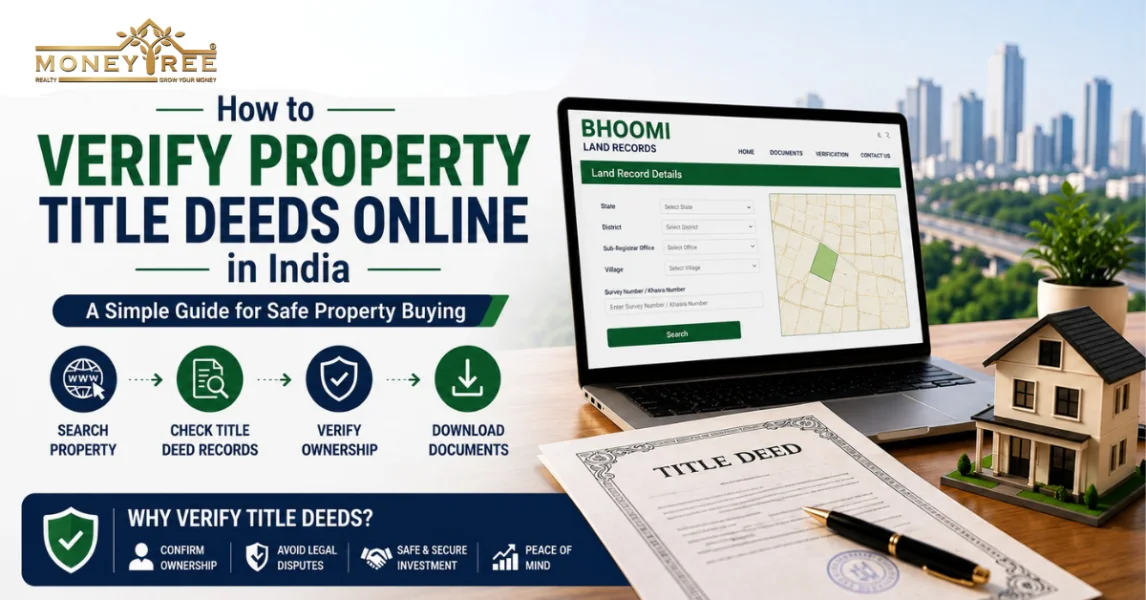
In this article, we will tell you about how to verify property title deeds online in India, what portals you can use for this, which documents you need to verify, and what the main warning signs are to pay attention to.
How to Verify Property Title Deed Online in India
Digital verification of property title deeds is a process where one verifies the documents given by a seller against the digital records available in the state revenue departments, Sub-registrar office (SRO), and municipal bodies. A property title is the document that shows the ownership and rights of any individual over a piece of property or land and a title deed, which could be the sale deed, etc., proves it.
In India, the process of verifying the ownership of the property involves government websites, where digitized versions of land registry, mutation, encumbrance certificate, and survey maps can be found. Being aware of how to verify property title deeds online in India allows a potential buyer to check on their own whether the seller actually owns the property legally, whether there are no banks’ mortgages or legal attachment on it, and whether the measurements of the property correspond to those on revenue maps.
What Documents Should Buyers Have at Hand When Verifying Property Title?
Before starting to look for the information online on state portals, one should have the original copies of certain documents at hand.
Sale Deed
The registered sale deed is the most important document for proving the transfer of the property rights from the vendor to the purchaser. This deed will have important information such as property description, total amount, stamp duty paid, boundary description, and registration information from the sub-registrar's office.
Mother deed/Parent documents
The mother deed or parent documents represent the past history of the ownership of the land or property from its allotment or first owner till the present owner. The verification of parent documents is essential to ensure that there is no break in the title chain for 13 to 30 years.
Encumbrance Certificate (EC)
The encumbrance certificate is a record of all transactions, mortgages, gifts, leases, or any other legal liabilities attached to the property over a specified period of time. A clean EC is the proof that the property is free from any encumbrances.
Documents related to prior sales and transfers
In case the property was sold more than once before, one needs to check the intermediate transfer documents, such as gift deeds, partition deeds, release deeds, wills, or inheritance deeds, to see how each of the previous owners got the ownership rights to that particular property.
Property tax bills
Property tax bills are proof that the property is assessed, the municipal charges have been completely paid up, and that local authorities recognize the present occupant/owner of the property.
Documents related to mutation
The mutation certificate, also known as Khata, Jamabandi, 7/12 Extract, and Namakaran in different states, confirms that the change in ownership has been made in the state records.
Documents related to RERA and others
For recently built and under construction properties, it is essential to check the RERA registration of the property, building plans approved, floor plan approvals, environmental clearances, and NA Land conversion.
Featured RERA Approved Properties & Pricing
Here under is a specially selected collection from the RERA approved properties from MoneyTree Realty, consisting of leading residential and commercial projects:
| Project Name | Location | Developer | Property Type | Size Range (Sq. Ft.) | Starting Price (INR) | RERA Registration Number |
| M3M The Cullinan | Sector 94, Noida | M3M Group | Luxury Residential & Retail | 3,200 – 6,000 sq. ft. | ₹6.5 Cr* onwards | UPRERAPRJ442214 |
| L&T Green Reserve | Sector 128, Noida Expressway | L&T Realty | Golf-Centric Luxury Homes | 2,004 – 3,200 sq. ft. | ₹6.24 Cr* onwards | UPRERAPRJ794300/09/2025 |
| Paras Avenue | Sector 129, Noida Expressway | Paras Buildtech | Commercial High-Street | 300 – 1,800 sq. ft. | ₹60 Lakhs onwards | UPRERAPRJ297873 |
| SVG Town Square | Alpha 2, Greater Noida | SVG Group | Retail Shops & Offices | 200 – 1,500 sq. ft. | ₹30 Lakhs onwards | UPRERAPRJ629900 |
| Godrej Crown Residences | Sector 27, Greater Noida | Godrej Properties | Premium Residential | 1,500 – 2,500 sq. ft. | ₹2.85 Cr* onwards | UPRERAPRJ438937/04/2026 |
| AIS The Galleria | Gomti Nagar Ext., Lucknow | AIS Developer LLP | Retail & Office Spaces | 250 – 1,200 sq. ft. | ₹38.95 Lakhs onwards | UPRERAPRJ418328 |
How to Verify Property Title Deeds Online in India: Step-by-Step
The online process for property title verification entails an orderly procedure. The following steps are important for verification of title deeds on digital portals of the government.
Step 1: Get basic information of the property
Basic search criteria can be obtained from the documents of the seller, such as:
Name of State, District, Sub-District, and Village/ Locality.
Survey Number, Khasra Number, Plot / Khata Number, or Property Identification Number (PID).
Location of Sub-Registrar Office (SRO), Registration Volume/Book number, and Document registration number, year of registration.
Step 2: Reach the land record website of that particular state
Visit the state-specific land revenue or registration website where your property is located. Make sure that you visit government websites only (with domain names such as .gov.in or .nic.in) in order to avoid any risk of being trapped on fraudulent websites.
Step 3: Check for the ownership record of the land
Insert the survey number, Khasra number, or Khata numbers of your property into the online search module available on the site. You can download the online record in PDF format (7/12 extract in Maharashtra, Jamabandi in Punjab and Haryana, Bhulekh Record in Uttar Pradesh, and AnyRoR in Gujarat).
Step 4: Verify the registered sale deed
Visit the Registration & Stamps department portal of the respective state government, such as IGRS, Uttar Pradesh, Inspector General of Registration, Maharashtra, or Kaveri Online, Karnataka. Use the document registration number along with the year to download the index of registered deeds and check stamp duty payment details.
Step 5: Verify the Encumbrance Certificate
Submit the request for an online Encumbrance Certificate (EC), covering a period of at least 13 to 30 years. Verify the issued Encumbrance Certificate (EC) and ensure that there are no liabilities such as banks, litigation, court cases, or release of mortgage registered on the property.
Step 6: Examine mutation records and property tax records
Access the official website of the municipal corporation concerned with the property (for instance, Noida Authority website, Greater Noida Authority, or Municipal Corporation concerned). Enter the tax assessment number or the property number to ensure that there are no pending property tax bills in the name of the seller.
Step 7: Examine the seller’s and property’s details
Compare the details of the seller's photo identification proofs (such as Aadhaar, PAN, and passport) with the owner's name, parents' names, and address as available in the government database to see that there are no typographical errors in the names or the absence of any legal heir of the owner.
Step 8: Compare downloaded government data with original documentation
Place the physical copies of the sale deed, mother deed, tax receipts, and mutation orders side by side with the government data downloaded from online websites. Compare the details of the plot area, boundaries, survey numbers, and registration stamp numbers.
How to Check Property Ownership Online in India
Knowing how one can verify property ownership on the Internet will help buyers ensure that the individual claiming ownership of the property is actually known to be the legal owner.
What kind of information related to property ownership can be checked?
Using state land revenue and sub-registrar websites, buyers can verify the following on their own:
Identification of errors in ownership documents
Errors usually arise in cases where there has been a change in ownership either due to physical transfer of ownership or through the sale agreement while the revenue/mutation document is not updated. In case there are sale deeds showing the present owner but the online revenue register (for example, Jamabandi/Khata) shows the previous owner or the ancestral dead person, the chain of title is not complete. One needs to first have the mutation done before making another sale.
How to Check an Encumbrance Certificate Online
Encumbrance Certificate (EC) is a vital document which shows registered encumbrances of a property for a certain period of time.
What EC reveals
The EC provides a thorough account of registered documents recorded at the Sub-Registrar office which includes:
How to verify whether there are loans, mortgages, claims or any registered encumbrances
In order to conduct an online search of the encumbrance:
An EC cannot establish
Though an EC may be crucial, there are certain limitations to its legal use. An EC cannot demonstrate:
How to Verify Property Documents Through State Government Portals
In India, the government at the state level operates specific websites for property registrations, land management, and municipal tax administration.
Land records
Revenues portal websites are responsible for managing records and documents related to land revenues, including ownership records, surveys, and revenue mutations. These include the following state revenues portals:
Registration department
IGR (Inspector General of Registration) portals help in searching registered deeds, checking property valuation in the market, applying for ECs, and verifying stamp duty payment. Popular portals are listed below:
Property and municipal records
Municipal corporations and development authorities take care of all the property and municipal records including plans, OC and local tax details. Industrial development authorities like Noida Authority, YEIDA and DDA run their portals to check the lease deed details and dues clearance.
Why different processes online state-wise
Administration of land and properties is within the jurisdiction of states as per the Indian constitution. As a result, each state makes its own digital database and process of searching and verification. While Maharashtra uses city survey number and 7/12 extract, Uttar Pradesh has Khasra and Khatauni numbers, Karnataka uses khata certificate and RTC. How to Check Whether a Property Has Clear Title.
The term a clear and marketable title implies the property’s ownership is free of any kind of claims or disputes, encumbrances or statutory limitations, and the owner enjoys full rights over it.
Continuity of ownership
Ensure that the chain of ownership moves continuously from buyer to buyer through the parent deeds without any break or any gap.
Pending claims or disputes
Find out if there is any civil suit against the property, partition dispute or any notices of land acquisition.
Liens/Mortgage
It should be ensured that the property is not pledged as security for any loan. The owner should ask the lender for a "No Dues Certificate" or a deed release if the property had any mortgage. The CERSAI (Central Registry of Securitisation Asset Reconstruction and Security Interest of India) website is consulted for checking equitable mortgages.
Inconsistency between property description in the sale deed and revenue maps
Plot size, Survey Number, House Number, and physical descriptions given in the sale deed should match with that on the online revenue map and site measurements exactly.
Common Red Flags During Online Property Title Verification
Where the seller does not have the original record/documents like old sale deed/mother. For those who are learning about how to check property papers online, there are several vital warning signs to be aware of as follows:
Name mismatch
Any difference in the name of the owner in the paper deeds, Aadhaar/PAN cards, and online mutation papers suggests either incomplete record entries or identity theft.
Break in the chain of title
A break in the chain of title means that there is no intermediate entry like, Owner A selling property to Owner C without mention of Owner B, making it a bad legal title.
Bank charge outstanding
A bank charge recorded in the Encumbrance Certificate/CERSAI portal signifies an active mortgage by the seller on the property.
Ownership issues
Claims to ownership by different parties, unsettled legal heirs' disputes, or court stay cases recorded in the land records are potential risks that require halting of the transaction.
Suspicious or unregistered documents
Transferring ownership through notarized documents, PoA that is not registered according to the Indian Registration Act, or simply paper receipt does not amount to legal transfer.
Differences between records of the government and that of the seller
Variances in total land size, boundary of the land parcel, or survey number in documents as compared to the revenue records should be sorted out immediately.
Can Verification of Property Titles Be Done Fully Online?
Even when digital portals make government records available easily, buyers should be aware of the extent of online verification.
What Buyers Can Verify Online
Online verification enables buyers to easily verify:
What still needs physical/legal verification
There are certain physical and legal verifications that cannot be done through online verification:
When to seek advice from a property lawyer
After conducting preliminary checks on the Internet, engage a professional real estate lawyer who will prepare a formal Title Search Report (TSR). A property lawyer examines original documents, advertises public notice in local newspapers, and provides a legal opinion on the marketability of the title.
Checklist of Property Title Validation for BuyersTo make things easy for you, use this handy checklist before entering into any agreement or transferring tokens:
Ownership
Sale deed
Title chain
EC
Mutation
Tax documents
Approvals & RERA
Identity of Seller
Conclusion
Undertaking due diligence and learning how to verify property title deeds online in India will ensure that your hard-earned money is not put at stake because of any sort of legal battle, hidden charges, or property scam. Land-record websites, Sub-registrar online search portals, and RERA websites can be used to learn about any issue related to ownership and past deals of the property.
It is important to note that online verification must be supported with offline verification of the document as well as legal consultation, when necessary. By combining online and offline due diligence, you will have more assurance, which is useful for making safe investments in property.
Want to find genuine RERA-registered properties in India? Get connected with MoneyTree Realty, India’s most trusted real estate advisor, to explore genuine residential, commercial, and land options. Our dedicated team can help you with the process of property selection, verification, and purchasing.
Frequently Asked Questions