




Table of Contents
The Indian real estate sector is undergoing many changes. The prices of properties, development of infrastructure, and the opportunity to invest in the industry are not the same in all cities. It is therefore necessary to understand the difference between Tier 1, Tier 2, and Tier 3 cities of India.
While Tier 1 cities like Mumbai, Delhi, Bangalore, and Hyderabad are known for their high property prices, well-built infrastructure, and job opportunities, Tier 2 and Tier 3 cities are being considered for their low property prices and growth potential.
In this article, we will focus on the distinctions between Tier 1, Tier 2, and Tier 3 cities in India, compare the prices of properties in these cities, and list all the cities that come under each tier. No matter if you are planning to buy a property for yourself, or for making an investment or entering into new real estate markets, this comparison will be beneficial for you.
What Are Tier 1, Tier 2 and Tier 3 Cities in India?
City tiers in India are used to determine how economically developed a city is. Originally introduced by the seventh pay commission to calculate house rent allowance (HRA) and split cities into X (Tier 1), Y (Tier 2) and Z (Tier 3) cities.
Full List of Tier 1 Cities in India
The following is a list of Tier 1 cities in India, which include eight major metropolises: Mumbai, New Delhi, Bengaluru, Hyderabad, Chennai, Kolkata, Pune, and Ahmedabad. All of these cities have economic significance and are well known for infrastructure, employment generation, and a good real estate market.
| City Name | State / Region | Major Economic Drivers | Average Residential Price Range (per sq. ft.) |
| Delhi-NCR | Delhi, Haryana (Gurugram), UP (Noida/Gr. Noida) | IT/ITeS, Corporate HQs, Aviation, Manufacturing | ₹6,500 – ₹24,000+ |
| Mumbai (MMR) | Maharashtra | Banking, Financial Services, Media, Trade | ₹12,000 – ₹45,000+ |
| Bengaluru | Karnataka | IT/ITeS, Tech Startups, Aerospace, Biotechnology | ₹7,500 – ₹18,000+ |
| Hyderabad | Telangana | IT Infrastructure, Pharmaceuticals, Genome Valley | ₹6,800 – ₹16,000+ |
| Pune | Maharashtra | Automotive Hub, IT/ITeS, Higher Education | ₹6,500 – ₹14,500+ |
| Chennai | Tamil Nadu | Automobile Manufacturing, SaaS, Healthcare, Ports | ₹6,000 – ₹13,500+ |
| Kolkata | West Bengal | Financial Hub of East India, Logistics, Leather & Jute | ₹4,500 – ₹10,500+ |
| Ahmedabad | Gujarat | Textiles, Chemicals, GIFT City Financial Services | ₹4,000 – ₹9,500+ |
Complete List of Tier 2 Cities in India
The complete list of Tier 2 Cities in India includes cities witnessing high development for both residential and industrial purposes due to government initiative and decentralization by companies.
| City Name | State | Key Infrastructure & Industrial Catalyst | Average Property Price Range (per sq. ft.) |
| Jaipur | Rajasthan | Tourism, Handicrafts, DMIC Corridor, IT Parks | ₹3,500 – ₹7,500 |
| Lucknow | Uttar Pradesh | Defense Corridor, IT City, Expressways, Metro | ₹4,000 – ₹8,500 |
| Chandigarh (Tricity) | Punjab / Haryana / UT | IT Park Mohali, Urban Planning, Healthcare | ₹5,500 – ₹12,000 |
| Kochi | Kerala | SmartCity Kochi, Maritime Port, Metro System | ₹4,200 – ₹8,000 |
| Indore | Madhya Pradesh | Super Corridor, Cleanest City Status, Education | ₹3,200 – ₹6,800 |
| Surat | Gujarat | Diamond Research & Mercantile (DREAM) City, Textiles | ₹3,500 – ₹7,000 |
| Coimbatore | Tamil Nadu | Textile Capital, Engineering, Software Export | ₹3,800 – ₹7,200 |
| Visakhapatnam | Andhra Pradesh | Major Port, Steel Industry, IT Hill No. 3 | ₹3,600 – ₹7,500 |
| Bhubaneswar | Odisha | IT Hub, Metals & Mining HQs, Smart City Rank | ₹3,800 – ₹7,800 |
| Vadodara | Gujarat | Chemical & Pharmaceutical Hub, Railway University | ₹3,000 – ₹5,800 |
| Nagpur | Maharashtra | MIHAN Cargo Hub, Central Logistics, Metro | ₹3,200 – ₹6,200 |
| Bhopal | Madhya Pradesh | Administrative Hub, Industrial Parks, Metro Project | ₹2,800 – ₹5,200 |
| Nashik | Maharashtra | Wine Capital, Auto Cluster, Defense Manufacturing | ₹3,200 – ₹6,000 |
| Dehradun | Uttarakhand | Educational Hub, Tourism, Institutional Headquarters | ₹4,200 – ₹8,500 |
| Patna | Bihar | State Capital, Commercial Trading, Metro Development | ₹4,000 – ₹8,200 |
| Thiruvananthapuram | Kerala | Technopark, Vizhinjam International Port | ₹4,000 – ₹7,800 |
| Goa (Panaji/Margao) | Goa | International Tourism, Hospitality, Real Estate | ₹6,500 – ₹15,000 |
Complete List of Tier 3 Cities in India
This list of tier 3 cities in India includes upcoming regional centers that are witnessing real estate developments due to good road connectivity, cheap land availability and regional industries.
| City Name | State | Primary Focus & Economic Activity | Average Property Price Range (per sq. ft.) |
| Udaipur | Rajasthan | Tourism, Handicrafts, Mineral Processing | ₹3,000 – ₹6,000 |
| Meerut | Uttar Pradesh | Delhi-Meerut RRTS Transit, Sports Goods Industry | ₹2,800 – ₹5,200 |
| Jhansi | Uttar Pradesh | Defense Industrial Corridor, Railway Junction | ₹2,200 – ₹4,000 |
| Aligarh | Uttar Pradesh | Hardware Manufacturing, University Town | ₹2,200 – ₹4,200 |
| Amravati | Maharashtra | Textile Park, Agricultural Processing | ₹2,000 – ₹3,800 |
| Jabalpur | Madhya Pradesh | Defense Factories, Tourism, Timber Trade | ₹2,200 – ₹4,200 |
| Solapur | Maharashtra | Textile & Garment Hub, Renewable Energy | ₹2,000 – ₹3,800 |
| Belgaum | Karnataka | Foundry & Hydraulics Cluster, Aerospace Hub | ₹2,500 – ₹4,500 |
| Tiruchirappalli | Tamil Nadu | BHEL Industrial Ecosystem, Educational Hub | ₹2,800 – ₹5,000 |
| Salem | Tamil Nadu | Steel Plant, Textile & Sago Industry | ₹2,500 – ₹4,500 |
| Gorakhpur | Uttar Pradesh | Industrial Corridor, Regional Trade, AIIMS | ₹2,800 – ₹5,500 |
| Bareilly | Uttar Pradesh | Furniture Trade, Agro-based Manufacturing | ₹2,200 – ₹4,000 |
| Rohtak | Haryana | Industrial Model Township (IMT), Education | ₹3,000 – ₹5,800 |
Differences between Tier 1, Tier 2 and Tier 3 Cities
In order to comprehend the difference between Tier 1, Tier 2 and Tier 3 cities of India, it is essential to compare these categories of cities on the basis of several criteria, which include population, infrastructure, employment opportunities, cost of living, property costs, connectivity, and real estate development.
Such criteria enable home buyers and investors to choose an appropriate city depending on their financial and lifestyle needs.The following is the comparative chart of Tier 1, Tier 2 and Tier 3 cities of India.
Population : Tier 1 cities are highly populated with a population of more than 4 million. This has resulted in high rise buildings to accommodate the huge number of people living here. Tier 2 cities have high rise buildings with condos but also have master-planned developments. They cater to a growing population of between 1-4 million. Tier 3 cities have low density with single occupancy homes and low rise apartments.
Transportation : Tier 1 cities have well connected transport systems including, functional metro systems, signal free flyovers and international airports with multi terminal systems. Tier 2 cities are quickly becoming well connected due to various state initiatives such as the Smart Cities Mission. They have BRTS within the city, more regional airports and connections to national expressways. Tier 3 cities have regional transport systems using state highways and regional railways. Improvements are typically focused on widening roads.
Employment : Tier 1 cities are major employment centres and attract jobs in IT/ITeS, investment banking, management roles in multi-nationals, and niche industries. Tier 2 cities are becoming centres for employment in corporations. With many IT back offices, financial technologies centres, automotive manufacturing and startups wanting to save on costs. Tier 3 cities see employment opportunities in government roles, regional trade, food manufacturing, local manufacturing and education.
Living Costs : Overall living costs are very high with high costs of housing, private schooling, eating out and transport. A large chunk of your monthly income will go on housing in Tier 1 cities. Tier 2 cities are cheaper to live in with good social infrastructure. International schools, multi speciality hospitals and shopping centres can be found here. Tier 3 cities are cheap to live in with basic lifestyle facilities.
Property Prices in Tier 1 vs Tier 2 vs Tier 3 Cities
There are variations in the prices of property in Tier 1, Tier 2, and Tier 3 cities in India owing to variations in factors such as infrastructure, population, job opportunities, connectivity, and housing needs.
The reason why Tier 1 cities experience high property prices is because of the developed real estate market and the demand that exists for property, whereas the other two types of cities have comparatively affordable houses and commercial properties. Here is how property prices vary in India. Here is the comparison between property prices in Indian cities.
| Financial Parameter | Tier 1 Cities | Tier 2 Cities | Tier 3 Cities |
| Average 2/3 BHK Apartment Price | ₹1.20 Cr – ₹4.50 Cr+ | ₹45 Lakhs – ₹1.20 Cr | ₹20 Lakhs – ₹45 Lakhs |
| Land / Plot Price Spectrum (sq. yd.) | ₹60,000 – ₹3,50,000+ | ₹15,000 – ₹60,000 | ₹5,000 – ₹20,000 |
| Average Gross Rental Yield | 2.5% – 3.8% annually | 3.5% – 5.2% annually | 2.0% – 3.5% annually |
| Down Payment Requirement (20%) | ₹24 Lakhs – ₹90 Lakhs+ | ₹9 Lakhs – ₹24 Lakhs | ₹4 Lakhs – ₹9 Lakhs |
| Housing Affordability Index (HAI) | Strained (35% – 69% of income) | Highly Affordable (23% – 30%) | Extremely Affordable (<20%) |
Average Property Rates
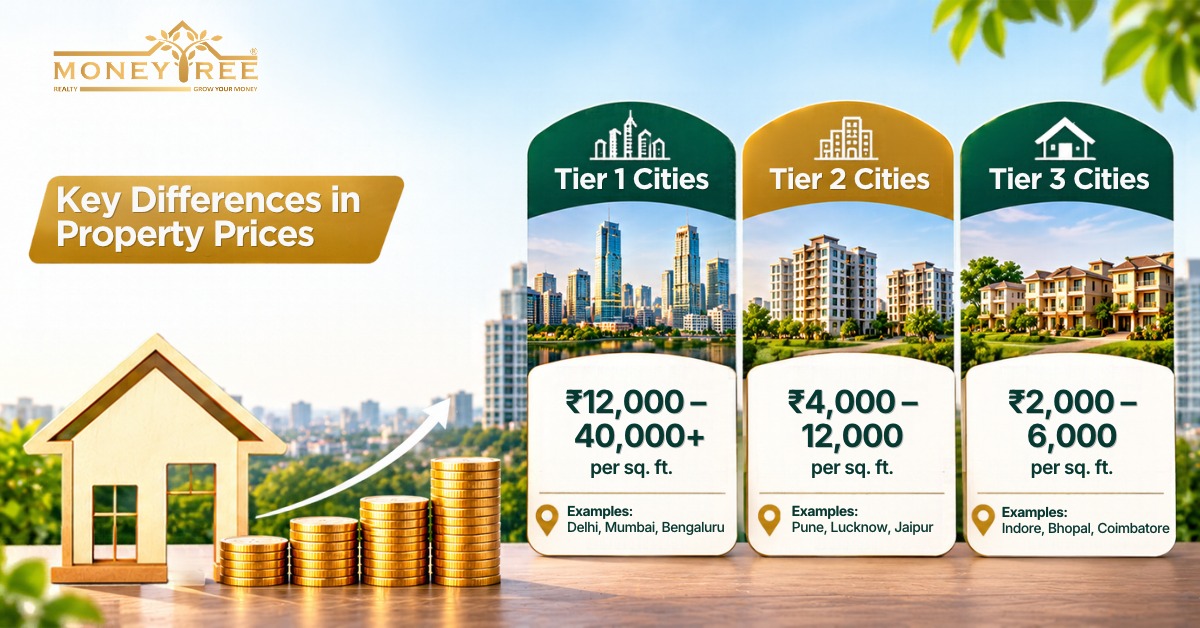
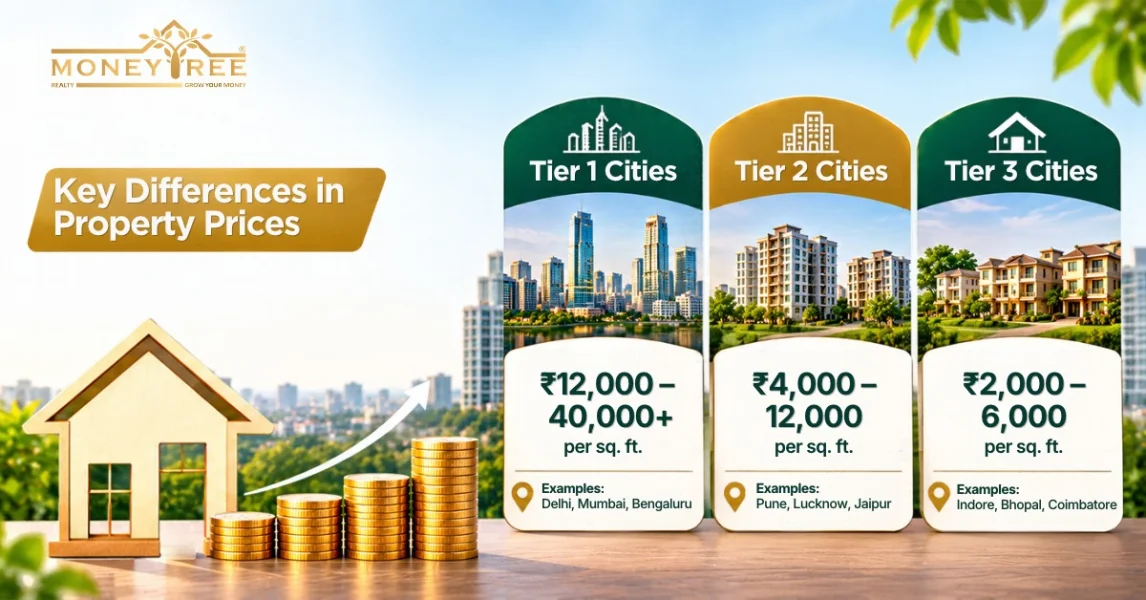
Tier 1 properties are priced at higher rates due to high land rates and strong branding by developers. The average selling price varies between ₹6500 per sq ft to above ₹25000 per sq ft.
Tier 2 cities offer an affordable range with prices varying from ₹3500 to ₹8500 per sq ft. This allows buyers from the middle income bracket to buy larger properties. Tier 3 cities offer prices from ₹2000 to ₹4500 per sq ft.
Land Rates & Plots
Plots are in short supply in Tier 1 cities, meaning plots are high in price. This means building your own property would be too expensive for an average salary earner.
Whereas Tier 2 & Tier 3 cities offer a good supply of plots approved by the authorities. This allows you to build your dream home at reasonable plot prices.
Rentals & Income Generation
Tier 1 cities will offer you higher monthly rental income (for example 3 BHK properties would earn between ₹35000 to ₹90000).
However, with the high property prices you will see low rental yields (2.5% to 3.8%). Tier 2 cities often offer much higher rental yields (3.5% to 5.2%). With low purchase prices and steady demand from tenants moving for corporate jobs.
Affordable Cities To Invest In
Tier 2 cities are an affordable option to invest in. You will generally only pay less than 30% of your average income on your property EMI.
Whereas Tier 1 cities often require two income earners to pay between 40% to 60% of their income on their mortgage.
Which Tier Offers Best Investment Opportunity?
The best tier to invest in depends on your investment goals, risk tolerance, how much you can hold and your capital.
Benefits Of Investing In Tier 1 Cities
Benefits Of Investing In Tier 2 Cities
Tier 3 Cities
What Is Driving The Growth Of Real Estate?
There have been many developments witnessed in the real estate sector in India because of urbanisation, infrastructural development, an increase in income levels, and a rise in the demand for residential and commercial properties.
The development of government policies, better connectivity, increased employment, and business expansion have also led to development in the real estate sector. Although Tier 1 cities remain favourites for real estate investment, Tier 2 and Tier 3 cities are gaining popularity owing to low real estate prices and infrastructural development.
Some of the main factors that have caused growth in real estate in Tier 1, Tier 2, and Tier 3 cities in India include:
Conclusion: What city tier should I invest in?
The decision of whether to invest in a Tier 1, Tier 2 or Tier 3 city will depend on your personal situation. Tier 1 cities will preserve your capital, offer high liquidity in their secondary market and have a strong tenant base of companies. They are perfect for high net worth investors. Tier 2 cities will give you a great balance between low entry prices, high percentage growth and high cash flow yields. When investing in property, it is important to invest in properties with verified developers and RERA information to ensure your investment is safe and profitable.
When investing in property, it’s important to research the market objectively. Work with MoneyTree Realty – the most trusted real estate advisors in India – to ensure you’re buying RERA approved properties with verified information. Our experts will help you make the right decisions to ensure you get high yielding property investments.
Frequently Asked Questions