Understanding RERA: What Homebuyers Need to Know in 2025
Posted on
May 20, 2025
Modified on Jun 11, 2026
Table of Contents
The Real Estate (Regulation and Development) Act, 2016 (RERA) has revolutionized India's real estate sector by enhancing transparency and protecting homebuyers. This guide covers essential RERA aspects for 2025, including project registration, builder requirements, and buyer rights. Understanding RERA is vital for making smart property investments and safeguarding your interests.
What is RERA? An Overview of the RERA Act India
The government enacted RERA (Real Estate Regulation and Development Act, 2016) to establish both regulatory measures and homebuyers’ protection within India’s real estate sector.
Every state and union territory needs to establish the Real Estate Regulatory Authority India which must supervise project approvals and address disputes between clients and developers.
Through RERA India builders must submit their projects which exceed minimum construction sizes to the authority thus boosting transparency.
Project information including map plans as well as financial documents and schedule of completion must appear on the RERA official website.
RERA serves a primary goal to fight project delays while combating real estate fraud by implementing firm deadlines that enact severe penalties.
The RERA compliance requirements for builders establish that they must store 70% of all funds obtained from buyers exclusively in an escrow account.
Under the Act homebuyers achieve power through defined RERA rights which specify their right to obtain properties on time with corresponding legal options against developer defaults.
Through RERA the country achieves universal standards yet enables states to create regulations particular to their location like RERA in Maharashtra or RERA Delhi guidelines.
RERA registration acts as a prerequisite for all builders who want to advertise or sell units since it establishes legal liability from the commencement of sales activities.
RERA demonstrated an advancement of moral business operations that fostered growing mutual trust between house purchase clients and real estate agents.
Importance of RERA: Why It Matters for Property Buyers
Through the RERA Act 2016 India buyers gained legal rights together with essential information that previously remained hidden.
The upcoming act includes measures for standardizing resolution of problems throughout the entire project development process.
RERA homebuyer regulations help property owners obtain their residences on time and construct penalties against developers who delay house deliveries.
Under the new regulations buyers receive safeguard against misleading product descriptions and obtain the promised products.
The Real Estate Regulatory Authority India gives customers the opportunity to file complaints alongside providing reasonable time-bound response protocols.
RERA establishes three fundamental rights for homebuyers through providing them access to project information while guaranteeing builders to deliver possession on contract terms and establishing refunds when builders do not meet their obligations.
Under RERA compliance norms builders maintain proper project execution while reducing the number of disputes.
Real estate market credibility increases as the Act develops trust between developers and their buyers.
Novice investors must learn about RERA because it enables them to purchase properties in a safe manner.
As a key mechanism it ensures both accountability and protects the thousands of property buyers throughout India.
How RERA Improves Real Estate Transparency in India
Real estate project registration requirements operate as a key measure that admits approved developments of high standards to market entry
Through the RERA portal developers need to publish information about project progress alongside delivery expectations and official documents and monetary reports.
The online system enables prospective buyers to confirm project information which decreases possibilities of fraud and inaccurate information.
Projects that complete RERA registration gain total transparency regarding their legal and financial construction aspects.
Buyers must keep 70% of their payments in escrow under the prohibition against fund diversion as per the law.
Ongoing project updates become mandatory through the RERA platform which enables buyers to monitor construction developments effectively.
RERA established a transparent information system through data using which all project stakeholders can access verified project details.
Different state portals including RERA in Maharashtra along with RERA Delhi guidelines represent among several transparency tools specific to one area.
RERA Compliance for Builders: What Developers Must Follow
All developers in real estate must obtain registration with their relevant Real Estate Regulatory Authority India before starting any activity of advertisement or unit booking or sale.
Project builders must supply exact information about projects that includes sanctioned plans together with layout and status of land title together with completion deadlines when submitting applications.
All received project funds from homebuyers must be deposited to a specific escrow account by developers who must allocate at least 70% of these funds.
Two-thirds of the project's enrollees need to grant their written approval for changes to occur in project specifications and plans.
The state RERA portal must receive updates about the quarterly projects which should contain both progress reports and financial data.
Projects must follow their agreed delivery schedules with buyers and late completion results in developers facing penalties along with compensation payments.
During a five-year period starting from when the owners obtain possession of their property the builders are required to resolve all structural issues and workmanship faults at no extra cost.
The failure to obey RERA rules results in project deregistration together with heavy fines and possible jail time.
RERA compliance practices in India enhance builders' trustworthiness while providing homebuyers with secure protocols for ethical development and construction.
Developers in Maharashtra and Uttar Pradesh are subject to particular compliance rules outlined by RERA in Maharashtra and RERA Uttar Pradesh updates.
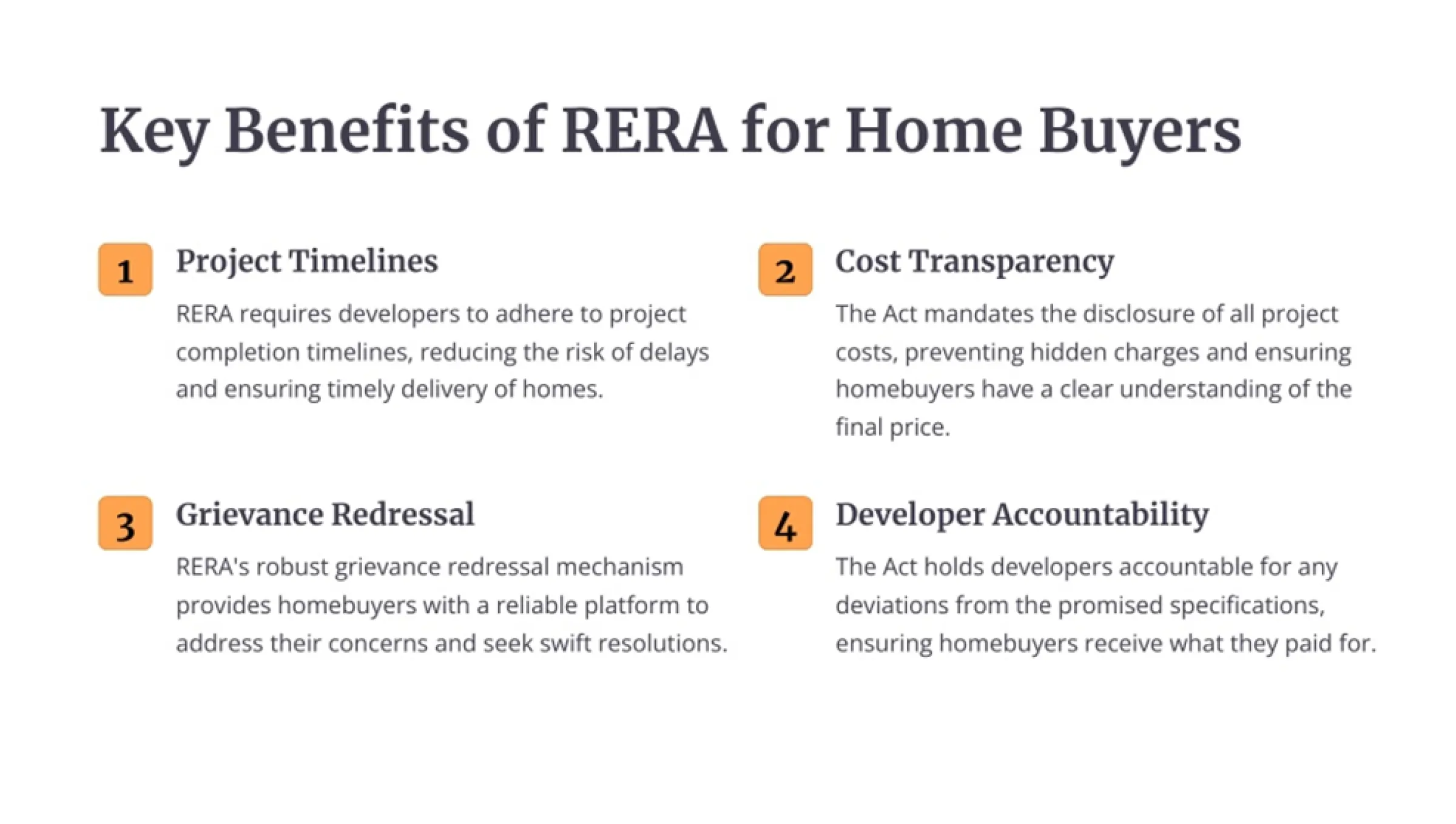
RERA for Homebuyers: Key Benefits and Protections
RERA Act India brings benefits to property buyers through its main goal of protecting their rights during home purchasing transactions.
Through the official Real Estate Regulatory Authority India portal buyers obtain authorized project details.
RERA provides homebuyers with three main benefits by ensuring lawful possession terms and project quality standards alongside builder transparency.
According to the rights of buyers they should receive their property on time otherwise they have the right to seek compensation or a complete refund.
Under the Act builders must respond to any delay and false information or defective points within defined time limits.
Through RERA for homebuyers the system only allows registered and compliant projects to be sold because this measure helps prevent fraudulent activities.
When disputes occur buyers can seek swift structured solutions by approaching the RERA authority and using its appellate tribunal.
RERA legislation generates enhanced homebuyer rights that both grant vulnerable status and financial capabilities during real estate deals.
The Act establishes standardized project documentation as well as contracts which eliminate both vague conditions and hidden contractual terms that had earlier harmed buyers.
Covers under RERA rules in Bangalore and RERA Delhi guidelines enable state authorities to protect regional buyers during their home purchase process.
How RERA Protects Buyers: Transparency and Accountability
How RERA Protects Buyers: Transparency and Accountability
Before initiating sales under RERA the builder must upload entire project specifications such as land titles and construction approval statuses and timeframes and cost estimates to the RERA portal.
Financial transactions operate under complete transparency because developers place seventy percent of project funds within escrow accounts which can only be used for the registered project.
The delivery of consistent construction updates and project modifications prevents the situation where buyers remain uninformed about their investments.
RERA establishes firm guidelines for preventing builders from using deceptive ads because it allows only registered and approved information to promote their projects.
The developer becomes responsible for legal compensation when terms agreed upon are not fully met.
RERA registration of projects establishes trust and maintains strict implementation standards across the property sector.
RERA offered buyers a regulatory system through which developers become accountable to their clients and the market experiences less fraudulent activity.
RERA Registration Process for Projects: Step-by-Step Guide
RERA Registration Process for Projects: Step-by-Step Guide
Real estate projects with sizes above a specific level must obtain registration through the RERA Act India before any promotional activities begin or sale activities start.
Each Real Estate Regulatory Authority India branch in a state requires developers to apply for project approval.
Projects seeking RERA registration must submit their land documentation together with financial information and plans for project layout and schedules for completion milestones.
Real estate builders must reveal carpet areas together with building construction updates and delivery timeframe expectations at the point of registration.
A developer receives their exclusive RERA registration number after approval before needing to use it for all promotional materials and advertising.
Builders gain trust from customers through RERA compliance registration and reach full compliance through this process.
Through the official RERA portal everyone can find verified detailed information for projects after RERA publishes it.
The authority requires builders to notify and gain approval for all upcoming project alterations together with delay reports which must reach prospective buyers.
Projects without proper registration status are deemed illegal which leads to possible heavy penalties together with legal action against developers.
Real estate transparency improves while homebuyers can trust their investments because of this process.
Why RERA is Important for Property Buyers in 2025 and Beyond
RERA Act India plays an essential role because of market growth to safeguard buyer interests while maintaining transparency and developer accountability.
The RERA system for homebuyers will guarantee developer adherence to changing consumer rights and project standards from 2025 onward.
Real estate fraud and missed deadlines along with price manipulation have decreased in the competitive market through the implementation of this real estate law.
RERA collaborates with urbanization to defend property purchasers through RERA legislation and create a proper system for urban residential real estate development.
The legal framework described by RERA keeps growing in sophistication by adding digital tools as well as toughening compliance requirements and implementing fast grievance resolution systems.
Home investors feel more secure when checking projects under the Real Estate Regulatory Authority of India because they conduct registration and verification and tracking of developments.
The importance of RERA compliance for builders will increase because the implementation of stronger performance evaluations and audits will be conducted.
States under RERA maintain upgraded systems that allow buyers to get verified data through web portals and regional circulars and automatic updates.
RERA substantially develops the property sector into a safe environment that safeguards investor funds while improving confidence between parties.
RERA operates as an important pillar which will sustain real estate transparency alongside empowering buyers throughout upcoming years.
RERA in Maharashtra: Key Highlights and Regional Guidelines
RERA in Maharashtra: Key Highlights and Regional Guidelines
Among all state authorities under RERA Act India MahaRERA functions as one of the most reliable and transparent bodies.
Project registration along with updates and complaint processing functions through MahaRERA platform remain accessible by users.
The state agency established more severe project delay and noncompliance penalties which improve builders' RERA compliance standards.
Through the portal users receive current updates about ongoing projects as well as construction status at any time.
MahaRERA works to educate buyers through seminars and maintains ongoing updates that reach the public.
RERA Delhi Guidelines: What NCR Home Buyers Must Know
RERA Delhi Guidelines: What NCR Home Buyers Must Know
The RERA governing body of Delhi operates throughout the National Capital Territory while following the rules that NCR does for real estate.
New development together with existing project registration requires developers to submit total disclosure according to Delhi RERA's requirements.
RERA Delhi implements three core requirements focusing on prompt delivery deadlines coupled with financial transparency measures and suitable dispute management procedures.
NCR home buyers receive prompt dispute resolutions together with robust protection based on RERA homebuyer rights.
As part of its mandate the authority performs agent regulation to guarantee that transaction processes must contain only certified professionals.
RERA Rules in Bangalore: Regulations for Builders and Buyers
RERA Rules in Bangalore: Regulations for Builders and Buyers
The state of Karnataka uses Karnataka RERA as its main authority to oversee residential along with commercial real estate transactions throughout the entire region.
All developers along with their agents need to maintain RERA compliance by registering their projects and updating construction updates on a regular basis.
The Bangalore RERA rules enforce mandatory timeframes while providing payment options to customers if developers do not meet their deadlines.
The Karnataka RERA portal allows buyers to verify how their projects received approvals along with land titles and as well as legal clearances.
The authority tracks down the benefits of RERA membership by spreading awareness to the public and keeping constant surveillance over the system.
RERA Uttar Pradesh Updates: Recent Changes and Impact
RERA Uttar Pradesh Updates: Recent Changes and Impact
Improvements for both compliance and buyer satisfaction have been introduced by Uttar Pradesh RERA (UP RERA) in 2025.
The system received decisive improvements through quick dispute settlement protocols and improved construction project monitoring and builder default fine adjustments.
The RERA Uttar Pradesh system intends to improve builder accountability through updates designed to provide homebuyers with updated information.
Through its portal UP RERA provides ongoing progress reporting and operates a grievance management system to assist buyers.
The real estate market of UP has become more trustworthy and beneficial for buyers due to these updated measures.
Money Tree Realty: Your Trusted Partner in Real Estate Investments
We at MoneyTree Realty got you!
We're a trusted real estate consultancy in Delhi/NCR, dedicated to transform your property search into a seamless experience.
Your Dream Space, Our Expertise
With over 300 skilled consultants, we offer a diverse portfolio of residential and commercial properties, carefully curated to meet your unique needs.
Partnering for Success
We've built strong relationships with industry giants like DLF, Tata, and Godrej, ensuring access to exclusive projects and unmatched expertise.
You Come First
At MoneyTree Realty, client satisfaction is our top priority. We harness technology to streamline your property journey, ensuring transparency, efficiency, and peace of mind.
A Track Record of Excellence
With over 10,000 delighted investors and a legacy of successful transactions, we're committed to setting new standards in Indian real estate.
Empowering Your Future
Join the MoneyTree family and discover a refreshing approach to real estate. Let's grow together.
Frequently Asked Questions
RERA stands for the Real Estate (Regulation and Development) Act, 2016, which aims to regulate the real estate sector and protect homebuyers in India.
RERA ensures transparency, timely project delivery, and legal protection, making the property-buying process safer and more reliable.
RERA provides buyers access to verified project details, enforces penalties for delays, and offers a legal platform for dispute resolution.
Yes, RERA is implemented in all Indian states and union territories, each with its own Real Estate Regulatory Authority.
You can visit your state’s official RERA website and search for the project using its name or registration number.
Yes, homebuyers can file complaints online or at the state RERA authority for issues like delays, fraud, or project discrepancies.
Non-compliant builders can face heavy penalties, project de-registration, or even imprisonment under the RERA Act.
RERA primarily covers under-construction projects, but some ready-to-move projects may also fall under its scope if they were not completed before the Act's implementation.
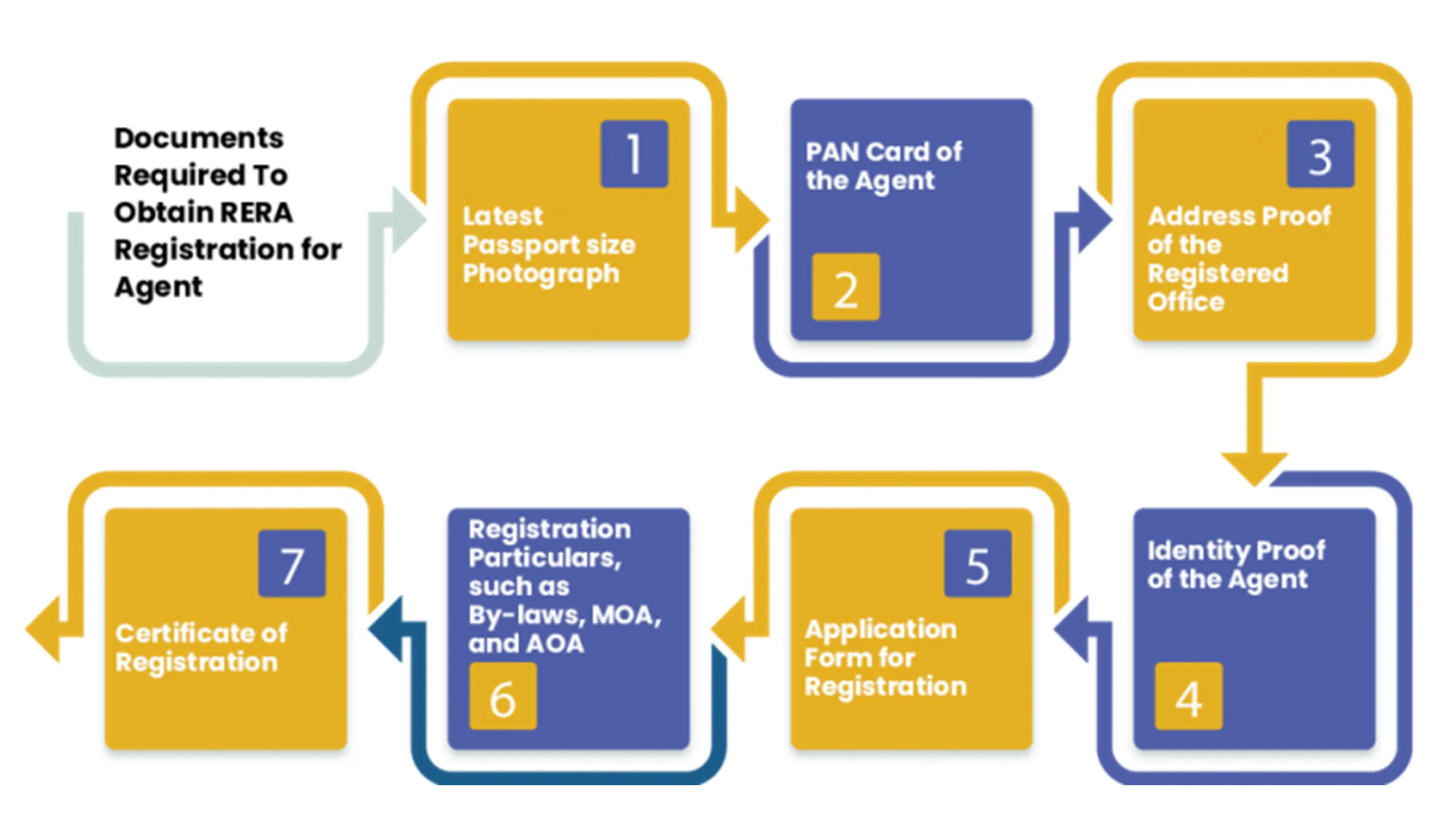
Yes, real estate agents must register under RERA and comply with its rules to operate legally.
Visit your state’s official RERA website (e.g., MahaRERA for Maharashtra, UP RERA, Delhi RERA) to access regional guidelines and project details.



.png)
.png)





-card.webp)