






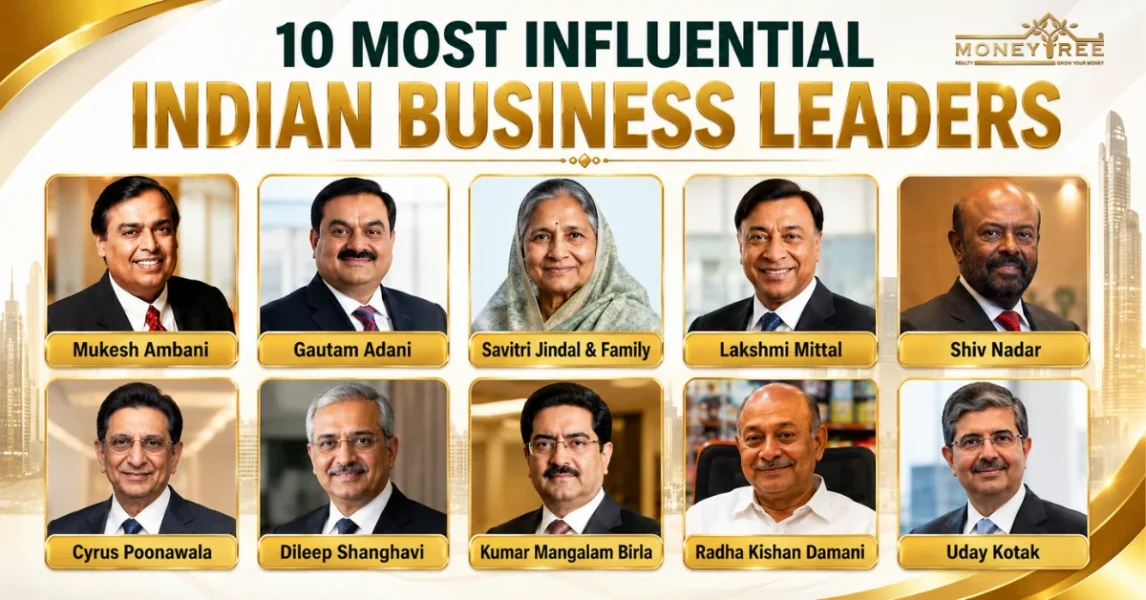
The Indian economy is growing in 2026, helping India emerge as one of the world’s key economies. The economic growth of India has also resulted in the emergence of many large corporations and entrepreneurs in various fields like technology, energy, infrastructure, pharmaceuticals, retail, finance, and manufacturing.
Examining some of the richest persons in India by 2026 gives us a fascinating insight into the creation of private wealth and the industries creating it. The richest Indians have created huge business empires that span multiple industries, whereas a number of them have also managed to diversify their wealth through various investments and assets.
They do not depend on their flagship ventures alone for their wealth. Through diverse investments in corporations and property in Mumbai, New Delhi NCR, and other financial centres, they have diversified their portfolio, in addition to their core business ventures.
This essay is based on the top 10 richest people in India for the year 2026, their approximate net worth, their main business, their investments, and the industry that has made them wealthy. The value of the individual’s net worth is subject to change due to market fluctuations; hence, it must be interpreted with the right source date.
Top 10 Richest Persons in India in 2026 - At a Glance
| Rank | Name | Primary Company | Primary Industries | Estimated Net Worth (USD) |
| 1. | Mukesh Ambani | Reliance Industries | Diversified (Energy, Retail, Telecom) | ~$99.7* Billion |
| 2. | Gautam Adani | Adani Group | Infrastructure, Ports & Energy | ~$92.6* Billion |
| 3. | Savitri Jindal & Family | OP Jindal | Steel, Power & Infrastructure | ~$38.3* Billion |
| 4. | Lakshmi Mittal | ArcelorMittal | Steel Manufacturing | ~$31.0* Billion |
| 5. | Shiv Nadar | HCL Technologies | IT Services & Software | ~$25.8* Billion |
| 6. | Cyrus Poonawala | Serum Institute of India | Pharmaceuticals & Vaccines | ~$26.8* Billion |
| 7. | Dileep Shanghavi | Sun Pharmaceutical | Healthcare & Pharmaceuticals | ~$25.7* Billion |
| 8. | Kumar Mangalam Birla | Aditya Birla Group | Diversified (Metals, Cement, Retail) | ~$21.8* Billion |
| 9. | Radha Kishan Damani | Avenue Supermarts (DMart) | Retail & Investments | ~$15.7* Billion |
| 10. | Uday Kotak | Kotak Mahindra Group | Banking & Financial Services | ~ $13.3* Billion |
Mukesh Ambani – Reliance Industries
Whenever the list starts about the richest person in India or who is the richest person in India? So Mukesh Ambani leads the list. His overall net worth ultimately counts $99.7 billion. Which is the highest net worth in India in 2026. Tell you that he is the Managing Director of JIO Reliance Industries Limited.
Mukesh has been able to convert his conventional company dealing with oil and chemicals into a multi-sectoral business organisation, such as consumer goods and technology, through Jio Platforms and Reliance Retail.
Gautam Adani – Adani Group
The Adani Group is a business entity operating in the realms of infrastructural and energy projects. It holds a dominant position within India's ports, power production and transmission, airports, and green energy transmission network. The quick amassing of wealth is due to the huge implementation of major infrastructural projects related to the growth of the country.
Savitri Jindal – OP Jindal Group
Savitri Jindal is the third-richest individual in India. She is the Chairperson Emeritus of the OP Jindal Group, which is India’s richest woman. The family business empire headed by her follows the footsteps of her late husband, O.P. Jindal, and holds ownership of many important steel, power, and infrastructure companies in Indian industry.
Lakshmi Mittal – ArcelorMittal
Lakshmi Mittal has changed the global commodities industry through his cross-border consolidation approach. This entrepreneur bought distressed state-owned steel plants located in Eastern Europe, Central Asia, and the Americas, and incorporated them into a well-connected corporate structure. At present, ArcelorMittal runs a business that controls the entire process of making automotive steel from the point of extraction of the raw material, iron ore.
5. Shiv Nadar
The IT revolution in India was initiated by Shiv Nadar himself, who converted his small hardware company into a large-scale software enterprise. Thanks to Shiv Nadar’s foresight and vision, his firm successfully made several transitions from the manufacturing of indigenous computers during the 1970s to cloud computing and AI technologies. Nowadays, his attention is split between corporate governance and enormous structural philanthropy.
6. Cyrus Poonawalla – Serum Institute of India
The work of Dr Cyrus Poonawalla has had profound implications for global health care through his ability to transform Serum Institute of India into the world’s biggest producer of vaccines. His principle of high volume-low cost production helped to break the monopoly of the West on vaccines and make these essential medicines available at affordable costs to poor countries. Today, SII produces more than 1.5 billion vaccines each year, covering about 65% of the world’s children.
7. Dilip Shanghvi – Sun Pharmaceutical
Under the stewardship of Dilip Shanghvi, Sun Pharmaceutical Industries grew from being a small company manufacturing psychiatric drugs, with only five medicines, into India’s biggest pharmaceutical company and a worldwide leader in generics.
Through shrewd acquisition of assets under distress, especially the turnaround of Ranbaxy Laboratories, he constructed an empire based on producing complicated generics and specialised medicines for chronic ailments. Currently, Sun Pharma provides affordable and quality medicines to more than 100 nations around the world.
8. Kumar Mangalam Birla
Kumar Mangalam Birla heads Aditya Birla Group, one of the best-known international business groups in India. The company is present in 36 countries and engages in different business operations such as cement, aluminum, finance, fashion, and paints among others.
As a result of Birla's leadership, the group has not only enhanced its international position but has also diversified into different consumer business segments within India.
9. Radhakishan Damani – DMart
The Indian retail industry has been transformed by Radhakishan Damani through his value investing approach in stocks to the grocery industry. By using Avenue Supermarts (DMart), he has managed to set up a highly efficient retail operation which is characterized by very cheap products, fast stock rotation, and an absence of any debt.
10. Uday Kotak – Kotak Mahindra Group
The Indian financial landscape was revolutionised by Uday Kotak, in transforming a modest bill discounting company into Kotak Mahindra Bank, an elite, all-embracing financial group. The firm became the first non-banking financial company in India to become a commercial bank in 2003.
Uday Kotak has built a worldwide reputation in risk management and corporate governance by creating a fortress balance sheet, which has helped him sail through various financial crises.
Where Do India’s Richest People Invest Their Wealth ?
Wealth creation needs intelligent use of capital management. The wealthiest in India in 2026 allocate capital intelligently into many important industries:
Real Estate
Ultra-wealthy individuals consistently park capital in high-grade real estate. A prime Real Estate Investment offers both wealth preservation and solid inflation-hedged returns. From land banks in expanding suburban corridors to luxury commercial and residential Property in Mumbai, real estate remains a top choice for portfolio stability.
Stocks & Listed Companies
A substantial chunk of billionaires' fortunes is tied up in their core promoter holdings in listed firms. The development of stock markets in India enables promoters to benefit from the public markets for their growth, along with the country's economic success.
Technology & Digital Businesses
From e-commerce and fintech to quick commerce and artificial intelligence, wealthy investors actively fund early-stage and growth-stage tech startups. Venture capital arms run by family offices ensure they stay ahead of digital disruption.
Infrastructure & Energy
In areas such as e-commerce, fintech, quick commerce, and even artificial intelligence, affluent investors actively invest in tech start-ups that are at early or growth stages. The venture capital arm of family offices makes sure they stay ahead of digital changes.
Healthcare & Pharmaceuticals
Life sciences and health care infrastructures remain lucrative ventures because of the global need for affordable treatments and vaccines.
Richest Person in India vs Richest Person in the World
Although India is home to some of the largest wealth owners in the world, a global ranking would paint a different scenario altogether:
The only difference between the two is geography, as international billionaires develop software/hardware solutions for global markets, while Indian billionaires develop huge infrastructures/consumer ecosystems within India to serve its 1.4+ billion people.
How Has India's Billionaire Wealth Changed in 2026?
In 2026, there were more than 220 billionaires in India, with an estimated wealth exceeding $1 trillion.
Conclusion
The success of the richest persons in India in 2026 reflects the economic growth of the country. The majority of such successful entrepreneurs have accumulated their fortunes by investing in the above-named spheres.
Real estate can be a key component in one’s investment strategy for those seeking to amass wealth in the long run. Whether it is luxury real estate property in Mumbai and other big cities, choosing the right property along with its location becomes essential.
If you wish to Real Estate Investment, then we at MoneyTree Realty will assist you in discovering genuine and appropriate properties for your budget and investment needs.
Reach out to us at MoneyTree Realty via +91-9732300007. We are India’s Most Trusted Real Estate Advisor and take the correct step to create your wealth through real estate.
Disclaimer: The information contained in this article, regarding net worth estimations, investment strategies, and analyses of business empires and the real estate market, is meant for informational, educational, and general reading purposes only. Net worth estimates have been made according to publicly available information and equity stock market prices, which are often fluctuating in nature.
Frequently Asked Questions