






Table of Contents
Comparison of a Ready-to-Move vs Under Construction property is a crucial decision when it comes to finances. Comparing the properties based on the Base Selling Price of the properties would not do as there are more costs involved.
While comparing ready to move vs under construction property, one needs to take into account the costs of GST, interest rate, pre-EMI, rental costs, charges for location and interiors. Hence, ready to move or under construction property – which is better will depend on one’s finances.
In this article, we have provided you with a ready-to-move vs under construction cost comparison along with a ready to move vs under construction which is cheaper.
Ready-to-Move vs Under-Construction: Key Differences at a Glance
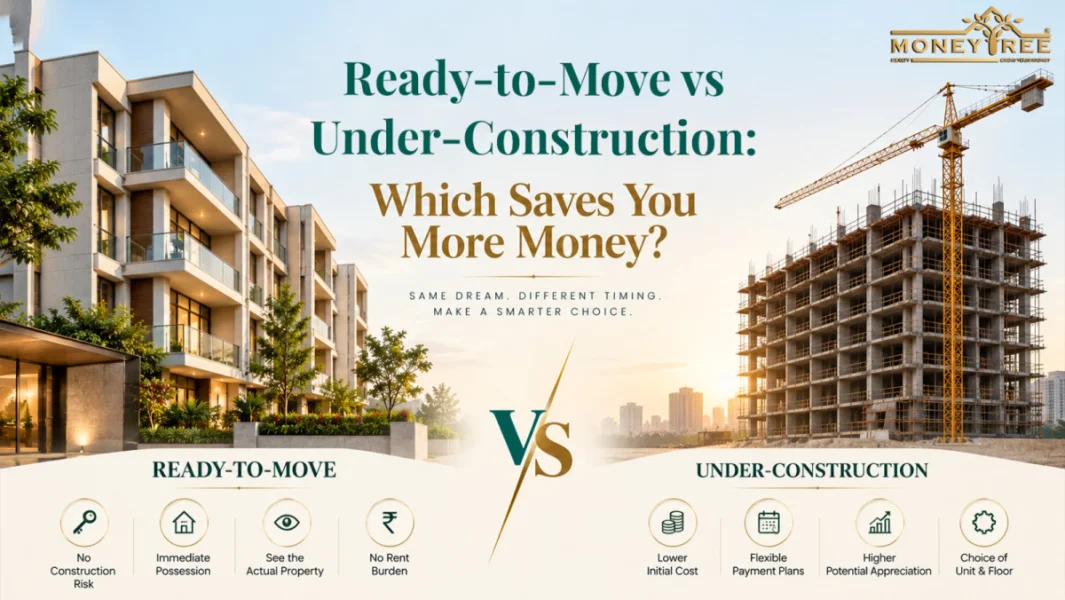
Properties that are ready to move in provide instant possession, reduced construction risks, and savings on waiting-period rents, although they usually cost more at the outset.
Properties under construction are less expensive at the beginning and have flexible payment options, although they also include waiting periods, delays in construction, costs of pre-EMI or interest payments, and temporary rents.
| Factor | Ready-to-Move (RTM) | Under-Construction (UC) |
| Initial Purchase Price | Higher entry price per sq. ft. | Lower entry price per sq. ft. (10% to 20% discount) |
| Payment Schedule | Lump-sum payment (typically 100% within 30–90 days) | Staggered payment linked to construction milestones |
| Possession Timeline | Immediate (30–45 days after documentation) | 2 to 4 years depending on build schedule |
| GST Applicability | 0% GST (if Occupancy Certificate is received) | 5% GST (Standard) / 1% GST (Affordable Housing) |
| Home Loan & EMI Burden | Full EMI starts immediately upon loan disbursement | Pre-EMI (interest only on disbursed amount) or Full EMI options |
| Rental Outflow / Inflow | Zero rent paid; immediate rental income potential | Ongoing rental expenses until physical possession |
| Risk Profile | Minimal; what you see is what you buy | Moderate to High; subject to execution delays and quality variation |
| Customisation | Very limited without demolition/rework | Higher flexibility during initial construction phase |
What Is a Ready-to-Move Property?
When a property is 'ready-to-move,' it means that the home is complete and ready to occupy on request from buyers. Such properties have obtained the mandatory occupancy certificate (OC) and completion certificate (CC) from municipal authorities within their jurisdiction. Infrastructural facilities and apartment units are fully fitted and ready for possession upon executing the sale deed and final payment.
When Possession Is Available
In possession of a ready-to-move unit, you can move in almost immediately upon completing legal formalities, clearing the title search report, disbursing home loan funds, and registering the registry deed, all typically completed within 30 to 45 days.
Who Should Consider a Ready-to-Move Property?
Buyers who currently pay huge monthly rents shall look to get a property that they can start occupying immediately to stop paying rent. End-users who desire to view the build's quality, survey the home's view, layout, and daylight exposure before committing to a sale.
Risk-averse buyers who seek to mitigate builder default or project restructure risk and ensure they pay only for completed projects and do not lose their invested money. Families looking to relocate immediately to be within the vicinity of schools or places of work.
Key Advantages and Disadvantages
Advantages
Disadvantages
What Is an Under-Construction Property?
An under-construction (UC) property refers to a residential unit in a project that is yet to complete excavation, structural framing/superstructure or finishing works. UC properties are purchased from developers before the issue of a Completion Certificate.
Construction and Possession Timeline
This timeline varies from 24 to 48 months depending on the scale of the project, high-rise structures engineering needs and the clearances by regulatory agencies. However, developers approved by the Real Estate (Regulation and Development) Act (RERA) are mandated to deliver the possession of keys at the completion of buildings within the timeline stipulated as the launch date on the state’s RERA portal.
Who Should Consider Buying Under Construction?
Key Advantages and Disadvantages
Advantages
Disadvantages
Ready-to-Move vs Under-Construction: Which Has the Lower Total Cost?
| Cost Component | Ready-to-Move (₹) | Under-Construction (₹) |
| Base Agreement Value | 1,15,00,000 | 1,00,00,000 |
| GST (0% vs 5%) | 5,00,000 | |
| Stamp Duty & Registration (~6%) | 6,90,000 | 6,00,000 |
| Pre-EMI Interest Paid During Wait (3 Years) | 7,20,000 | |
| Rent Paid While Waiting (₹30,000/mo × 36 mos) | 10,80,000 | |
| Interiors & Fit-outs | 5,00,000 | 6,50,000 |
| Effective Net Cost | 1,26,90,000 | 1,35,50,000 |
In this scenario, though the initial base price is higher by ₹15 Lakh, the ready-to-move property leads to lesser outlay due to saving on GST, rental, pre-EMI interest.
GST on Ready-to-Move vs Under-Construction Property
GST is not applicable on ready-to-move property, if the developer has received the Completion Certificate (CC) or Occupancy Certificate (OC) from the competent authority before executing the sale agreement. As compared to under-construction property, it is treated as sale of immovable land/building and not services.
When is the GST applicable on under construction homes?
In case of under construction houses, based on the unified GST guidelines for real-estate:
Tax verify before booking
Home Loan and EMI: Which property type saves more?
Knowledge about Pre-EMI and Full EMI is very much crucial for Ready-to-Move and Under-Construction properties.
In the case of an under-construction house, the loan amount is paid by banks to the developer in instalments depending on the progress of the project. In a Pre-EMI scheme, the buyer pays interest only on the disbursed amount until he or she gains possession of the property. However, in Full EMI, the payments consist of both the principal and the interest, which enables reduction of the total loan balance right from the beginning.
Interest Aspects
Any delay in the project can cause the borrowing cost to go up tremendously. If there is any delay in the project by two years, then the buyer who opts for the Pre-EMI scheme will be required to pay extra interest for two more years on the disbursed amount.
This means that when choosing between ready-to-move and under-construction, whichever is cheaper, buyers should consider the interest part as well.
Hidden costs buyers should know
The comparison between Ready to Move and Under Construction properties requires a buyer to consider more than just the price quoted for the property.
1. Rent paid during construction
If you are living in a rented house till the time you get possession of the property, this rent is definitely a sunk cost and adds to the total cost of your purchase.
2. Construction delays and holding costs
Delays in construction lead to increase in holding costs, more rent paid during construction as well as pre-EMI as the possession delays.
3. Interior, modification costs
Ready to move property would have flooring, washrooms, electrical fittings fitted, whereas in case of under construction, you may need to spend on modification and layout changes if not already included. Developers may also levy extra charges if you want to change the layout from what is displayed in their show unit.
4. Advance maintenance + Interest free maintenance security – IFMS
Advance maintenance charges (interest free maintenance security IFMS) as on the date of possession, is what developers levy on the buyer on the basis of 1-2 years advance maintenance. This ranges between ₹50-150 per sq. ft of super area.
5. Floor rise and PLC (preferential location charges)
Both Ready to move and under construction properties charge an extra amount for floor rise (higher floors or ones with view of park), PLC (preferential location charges) to cover the corner or specific flat. These charges range between ₹100-500 per sq. ft.
6. Capital Immobile – Opportunity cost
The opportunity cost of the capital invested in the form of down payment or even retained payment if the possession is delayed. If the market gives around 10-12 % returns on these funds the opportunity cost would be very high.
Which Offers Better Value: Lower Price or Immediate Possession?
When comparing Ready-to-Move vs. Under-Construction properties, a lower advertised price does not always mean better value. Buyers should compare the final purchase cost with the actual usable space and benefits of immediate possession.
Usable Value Efficiency Ratio
Usable Value Efficiency Ratio = Actual Carpet Area ÷ Super Built-up Area.
A higher ratio indicates that a greater proportion of the purchased area is actually usable.
Discounted base price vs actual usable value
Projects which are yet to be launched tend to give a false sense of value as they display base selling price (BSP) which does not account for various cesses and charges like external development charges (EDC), infrastructure development charges (IDC), club membership, parking and GST which when added to it, increases the final price to a great extent and decreases the value proposition.
Carpet area
As per the real estate regulatory authority (RERA) guidelines, a developer needs to quote Carpet area and not the super built-up area. Carpet area helps calculate the actual area that can be used in the property as one can measure the area manually against the given carpet area. In case of a ready to move property, one can even measure the room sizes and height of the rooms.
Financial Calculation Framework: True Cost Formula
To accurately compare total costs between property types, use this formula before signing a booking agreement:
TCORTM=Pbase+Sstamp+Iinteriors+Madv+∑EMIfull−Rearned
TCOUC=Pbase+TGST+Sstamp+Iinteriors+Madv+∑EMIpre+∑Rpaid
Where:
Pbase = Base Agreement Price
TGST = Goods and Services Tax (5% for standard housing)
Sstamp = Stamp Duty and State Registration Fees
Interiors = Out-of-pocket interior fit-out costs
Madv = Advance Maintenance and Security Deposits
EMIfull = Total mortgage interest paid before property stabilization
EMIpre = Cumulative pre-EMI interest paid during construction
Repaid = Total rent paid while waiting for possession
Rearned = Rental income generated post-possession
Ready-to-Move vs Under-Construction: Which One Should You Choose?
Choose Ready-to-Move If:-
Choose Under-Construction If:-
Conclusion: What Type of Property Saves More Money?
In evaluating whether to go for Ready-to-Move or Under-Construction apartments, the one that proves to be cheaper largely hinges on the rental payments you make, down payments, finance charges, and the duration of your investment plan.
A not-yet-completed building will have a lower purchase price and may be paid in instalments. However, there could be an added expenditure from GST, pre-EMI interest, and rent during the construction period. On the other hand, ready-to-move properties will need a higher down payment. However, there will be an instant takeover and savings on rent.
Rather than comparing just the per square foot rate, try to look at the total cost of acquisition, which includes GST, pre-EMI interest, rent, down payment, and other costs involved.
Are you searching for a suitable property in Noida, Greater Noida, or Gurgaon? Moneytree Realty, India's most trusted real estate advisor, assists homebuyers and investors in making sound property choices.
Contact us now at + 91-9732300007 and discover the verified residential and commercial properties that will suit your financial needs and expectations.
Frequently Asked Questions