






Table of Contents
You must know the meaning of three terms: carpet area vs. built-up area vs. super built-up area when purchasing property, because this will help you compare properties as well as know the actual usable area of the property you have purchased.
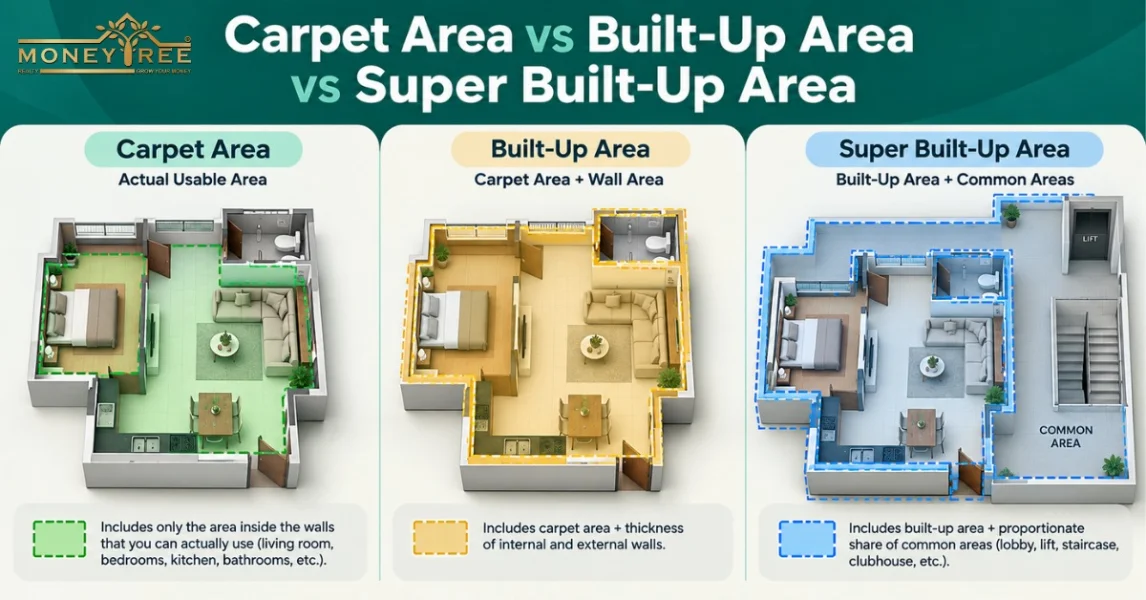
Carpet area means the usable floor area of your house. The Built-Up Area is usually made up of the carpet area as well as the wall thickness, whether internal or external, as well as applicable areas like balconies. Super Built-Up Area takes it a step further by including your share of the common areas.
The builders can quote the price of the property according to the Super Built-Up Area, which is also referred to as saleable area. The gap between carpet area and saleable area is normally related to the loading factor. In RERA, the carpet area of RERA is one of the most significant measurements in the real estate market.
In this article, we shall try to distinguish between the terms carpet area, built-up area, and super built-up area, explain how to calculate carpet area, explain the meaning of the loading factor, and discuss the areas that need to be taken into account while purchasing a property. Knowing these terms will help you compare properties and evaluate your purchase.
At a Glance Comparison
| Area Type | Quick Meaning | What You Actually Pay vs Use |
| Carpet Area | Net usable floor area | Space lives daily |
| Built-Up Area | Carpet area + walls & balconies | Total private boundary of the flat |
| Super Built-Up Area | Built-up Area + shared spaces | The total saleable areas billed by the builder. |
What Is a Carpet Area?
The carpet area is the space within your apartment that can be utilised by placing furniture, moving around, and performing your day-to-day activities. The carpet area usually does not include the thickness of outer walls and common areas like lift shafts and corridors. In simple terms, it is the area from the inside surface of one wall to the inside surface of the other wall.
What Is Included and Excluded?
Included: Bedrooms, lounge, dining, kitchen, bathrooms, storage rooms, and internal stairs.
Excluded: Thickness of external walls, common corridors, lifts, clubhouse, and shared stairs.
RERA Carpet Area
As per the provisions of the Real Estate (Regulation and Development) Act, 2016 (RERA), the developers in India are required to sell the properties as per the concept of the RERA Carpet Area.
RERA Carpet Area = Usable area of an apartment + Partition Walls
It does not include external walls, common areas, or exclusive open terrace/balconies.
Why Carpet Area Matters to Homebuyers
The carpet area gives an idea of the true size of the living space. It ensures that one does not have to pay residential prices for corridors and thick walls.
What Is a Built-Up Area?
It is the complete structural area of your flat. This means the usable area plus the area covered by internal structural walls and exterior boundary walls, and exclusive outdoor structures such as balconies or utility ducts.
What Does The Built-Up Area Include?
In the built-up area, the following are included:
- Total usable area is also called carpet area.
- Thickness of walls inside and outside.
- Balconies and terraces belong to owners.
- Area for utility services, if applicable.
Carpet vs Built-up Area
The distinction is quite simple: the carpet area denotes the area that is usable in a flat, while the built-up area is defined as the area occupied within the flat as well as the walls and private areas such as terraces. This can be a significant point for comparing the sizes and the prices of different properties.
For example: if we have a flat area of 800 sq. ft., adding some other 100 sq. ft. for the walls and another 100 sq. ft. for the balcony, the area will be about 1,000 sq. ft. in total. Understanding the difference can help to assess the size and valuation of the property in the future.
What Is a Super Built-Up Area?
Super Built-up Area, also referred to as the saleable area, is the total area considered by the builder to estimate the price of the flat. This will include not only the built-up area of the flat but also the proportionate area of the common area of the building. It can be described as the total area that is being paid for while buying the property.
What Does Super Built-Up Area Include?
Subject to the specific project, the super built-up area can consist of your proportionate share of common areas, including:
Super Built-Up Area vs Saleable Area
The super built-up area and the saleable area are basically the same terms that are commonly used in the Indian real estate industry. This term is normally used by the developer when calculating the price of the property. This is because it usually consists of part of the common areas.
Simple Example
For instance, if a flat has a built-up area of 1,000 sq. ft. and your proportionate area of the common areas like the lobby, corridor, and lift is 250 sq. ft., then the super built-up or saleable area will be 1,250 sq. ft. Knowledge of this difference may assist in comparing the size of the apartments and their prices.
Carpet Area vs Built-Up Area vs Super Built-Up Area: Side-by-Side
| Area | What it Means | Usually Includes |
| Carpet Area | Usable area inside the apartment | Bedrooms, living rooms, kitchen, bathrooms, internal store space |
| Built-Up Area | Carpet area plus walls and exclusive balconies | All carpet spaces, wall thickness, private balcony/utility areas |
| Super Built-Up Area | Built-up area plus proportionate common areas | Built-up area, shared corridors, lifts, lobbies, staircases |
How to Calculate Carpet Area, Built-Up Area, and Super Built-Up Area
By knowing how to calculate carpet area, built-up area, and super built-up area, it becomes much easier to analyse and compare different properties.
Simple Formulas
What Is The Loading Factor?
It is an extra space added to the total usable space of the flat to cater for the space that will be used for the common facilities like the lobby space, staircases, lift spaces, and many more. It is an important factor when comparing property prices and apartment sizes. .
Super Built-Up Area = Carpet Area multiplied by (1 + Loading factor)
Practical Example: 1,000 sq. ft. Super Built-Up Flat
Let us examine the space distribution in a super built-up flat of 1,000 sq. ft. having a loading factor of 25%.
Super Built-Up Area: 1,000 sq. ft
Shared Common Space (25% Loading): 1,000 Multiply 0.25 = 250 sq ft.
Built-Up Area: 1,000 - 250 = 750 sq. ft
Actual Carpet Area (minus walls & balcony space): 675 sq. ft.
What Is The Loading Factor in Real Estate?
Loading means the extra percentage required to get the saleable or super built-up area from the carpet area. Loading normally consists of the buyer’s share in common areas like lobbies, corridors, lifts, staircases, etc. It is essential for people who are buying houses to know about the loading percentage since it will help them calculate the usable area as compared to the total area for which they are paying.
How Loading Increases Saleable Area
In case of projects with luxurious facilities like big and multi-story club houses, huge air-conditioned lobbies, and grand halls, the loading factor increases. The loading factor in premium luxury projects is 30% to 40%, while that of normal residential projects lies between 15% and 25%.
Why Buyers Should Check Loading Before Purchasing
Even though the rate per square foot seems to be cheaper in the first place, you may be surprised to learn that a lot of spaces included in your calculations are not the rooms you actually use.
Which Area Should You Consider When Buying A Flat?
When analysing flats, the first and foremost factor you need to look at is carpet area. By comparing the flats using their carpet area, you get the actual price of your flat.
Which Area Should You Consider When Buying A Flat?
When analysing flats, the first and foremost factor you need to look at is carpet area. By comparing the flats using their carpet area, you get the actual price of your flat.
Conclusion: Know the Actual Area Before Buying a Property
It is important to know about the distinctions between carpet area, built-up area, and super built-up area, as this will help you to assess the true measurement of your property. The carpet area will give you a better idea about the actual usable space within your house, while the other two areas include extra areas.
Before buying a property, always check the RERA carpet area, the approved floor plan, total price of the property, and loading factor before signing any purchase agreement. Comparing properties based on carpet area can further help you determine how much you are actually paying for the usable space.
For detailed guidance regarding residential property, you can always contact MoneyTree Realty, India's most trusted real estate advisor. Our professional experts will guide you in all aspects, including information of the property, RERA information, floor plan assessment, and comparative pricing. Contact us now on +91-9732300007.
Frequently Asked Questions