






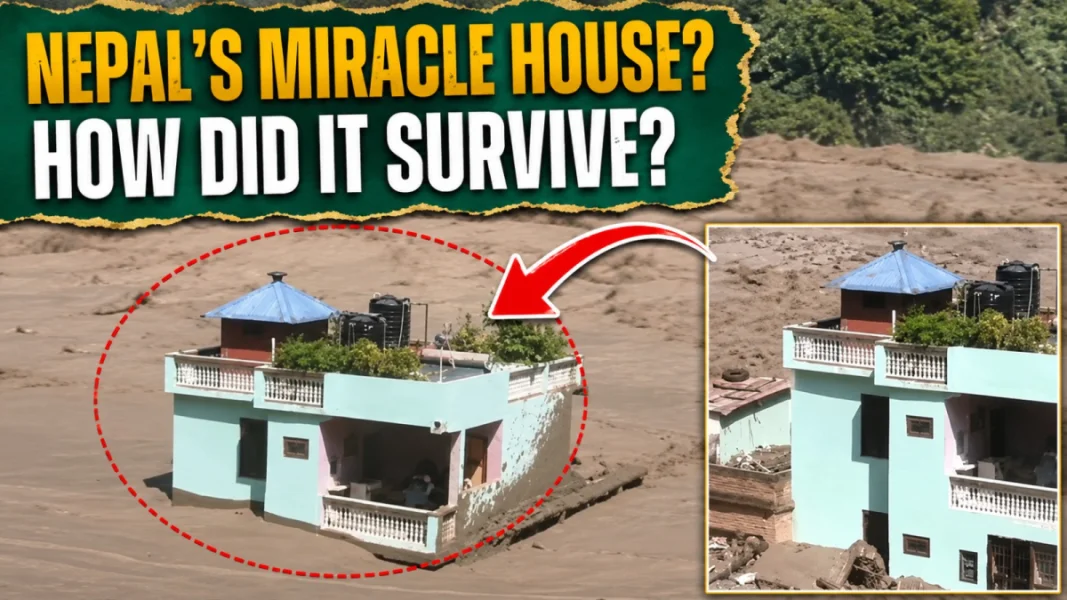
A deadly flood hit northern Nepal on the morning of Wednesday, August 26, 2026. According to reports, the flood occurred due to the sudden collapse of a glacier around Langtang Lirung, located on the border between Nepal and Tibet. The result of this was that huge volumes of debris and mud were released into the area.
As reported by the United Nations (UN), over 1000 + deaths have already been confirmed due to the tragedy that has taken place, while thousands of other individuals are still missing, with rescue efforts underway. Hundreds of thousands of people have been displaced as the valleys of rivers have been flattened.
The imagery shows a terrifying scene: almost every nearby building was swept away or obliterated by the wall of water and debris. Standing remarkably intact in the middle of this devastation, however, is a single bright green house Nepal flood survived.
Such a scene has amazed everyone. How is it possible that such a small structure survived in the Nepal flood environment where everything else was washed away? How did it withstand the strong sideways pressure of the flowing river?
Now let us look at the six major reasons why the house survived the Nepal flood, and what the viral story of the Nepal house surviving a flood tells us about building houses.
What Happened in Nepal's Flash Flood?
The heavy rains during the monsoon season in Nepal led to severe flash floods throughout many river valleys. The consistent rainfall in the mountains resulted in turning the streams into raging rivers, carrying water, mud, stones, and huge rocks.
The destruction was widespread. The river waters entered the residential zones, destroying buildings, roads, bridges, and power cables within seconds. The structures that were made from brick, stone, and other conventional materials could not withstand the immense force of the floods.
Amid all this destruction, however, one Nepal house survived the flood, leaving people stunned. A photograph showing a green house still standing while much of the surrounding area had been devastated quickly went viral on social media.
The image has raised a simple but fascinating question: why did the house survive the Nepal flood when so many other buildings were destroyed? The solution may be found in one of these elements: location of the house, its foundation, quality of construction, the nature of the terrain around it, and the direction from which the floods came.
Well then, what made this house unique and allowed it to survive such a catastrophic flood? Let’s see.
The Green House That Survived The Nepal Flood
Viral video clips of the house showed a large and brightly colored green structure standing out quite prominently amidst a path of mud, while other houses nearby had been destroyed.
The house was situated beside an overflowing riverbank, which was prone to receiving very swift floodwaters with mud and rock formations. Luckily, it seems that the occupants had successfully evacuated before things became too bad.
The image of this Nepal house surviving the flood quickly attracted attention on social media, leaving viewers stunned by the contrast between the standing green house and the destruction surrounding it.
Of course, it was quite natural for many to ask: how is this house standing tall even after experiencing floods in Nepal when the other houses have been swept away?
Several factors were responsible for the house's existence, including the solid foundation of the house, the materials used for building, the position of the house in relation to the movement of the floodwater, among others.
Then comes the question: What was different about this particular house?
Why Did This House Survive When Others Collapsed? 6 Possible Reasons
This structure surviving the Nepal flood house might appear unusual; however, there are quite a number of factors that could be responsible for its survival while other houses were destroyed.
1. Strong RCC Structure
The house seems to be constructed using reinforced cement concrete. In simple words, steel bars are used in the concrete columns and beams, which makes the structure very strong. In case a lot of floodwater attacks the house, it will be able to withstand much more load than a structure that is not sturdily constructed. This may have helped the house survive the Nepal flood.
2. Everything Was Strongly Connected
RCC house comprises beams, columns, and a foundation, which are all bonded together to work as a whole. Hence, in case water exerts force on any one side of the house, then pressure is exerted on the whole house.
3. It May Have Avoided the Strongest Part of the Flood
Floods do not always carry objects with equal strength. There are some places that contain big rocks, trees, and other massive debris, and there are others where only water and mud can be found.
The house might have been situated a little away from the path of such heavy things. That is why although it was caught in the flood, it was safe from such massive boulders and debris.
4. Its Simple Shape May Have Helped
The structure is relatively simple in form. This could have been one of the factors that led to the water splitting into two and going around both sides of the building.
An unusually shaped building exposes more surfaces to the water and can therefore be subjected to more force than a normally shaped building.
5. The House May Have Been on Stronger Ground
It is also possible that the location of the house played an important role in the flooding. A relatively small elevation above the land around the house would have helped to lessen the amount of water striking the structure.
The ground conditions played an important role in this situation. Solid soil or bedrock below the foundation would have helped to prevent movement.
6. Mud and Debris May Have Changed the Water's Path
When the flood swept through, it brought along huge masses of mud, gravel, and debris. This could have accumulated around the house.
What is surprising is that this layer could have diverted the flow of subsequent water flows, forcing them to bypass the house rather than go right through it.
Why Did the Green House Survive?
Maybe there isn't only one reason why this green house in Nepal was still standing after the flood. It might be because of its sturdy construction, solid foundation, site, shape, and the flow of the flood water around it.
Without any proper examination of the structure and surrounding environment, this remains a possibility.
Why Did Nearby Houses Collapse?
Whereas the green house survived, many other surrounding houses were not able to withstand the force of the floods. There are three reasons that could be responsible for their collapse.
Was It Engineering, Location, or Luck?
The viral survival of the Nepal flood house must probably have been the outcome of multiple reasons. Rather than being solely reliant on one of these reasons, it could be that a combination of good building, location, and luck kept it alive.
Strong Construction + Safe Location + Luck = Building Survival
The RCC construction might have been enough for the house to resist the strong floodwater. The sturdy foundation and firmer ground might have also been helpful for avoiding soil erosion and damage.
However, the house might have been located a little bit away from the path of the debris, thus being protected from any falling rocks, trees, and other debris.
It may be that this explains how the house survived in the flood in Nepal, where many other buildings around were destroyed.
This may mean that it was engineering combined with the location and good luck that helped to keep the structure standing. Without the combination of these three factors, things could have ended very differently for this house.
But without an engineering inspection of the structure and the surroundings, this is just speculation.
What This Viral Nepal House Teaches Us About Flood-Resistant Homes
The story of the Nepal house that survived the flood offers an important lesson about how stronger planning and construction can help protect homes in areas at risk of natural disasters.
1. Invest in Good Structural Engineering
If the construction of a building is done effectively, then it will be able to withstand much more force than a structure that was not constructed by professionals. It could make a huge difference in cases of floods and earthquakes.
2. Use Strong RCC Frames
The Reinforced Cement Concrete (RCC) structure gives strong support to the whole building. Properly joined columns and beams might have helped the house to resist the very strong lateral forces caused by the flowing water.
This could be one of the main causes for which the greenhouse in Nepal flood video gained such popularity.
3. Check the Soil Before Building
A sturdy home also requires a good foundation. Engineers can conduct tests on the soil before building to check if it is suitable for supporting the structure.
Sound soil can minimise the chances of foundation shifting, soil erosion, and damage from the rushing water flowing through the region.
4. Plan for Flood Risk
The basic lesson learned from the building that withstood the Nepal flood disaster is that of selecting the appropriate site for construction.
It would be ideal if the buildings were constructed far from the river courses, natural routes of water flow, and also low-lying areas, where flooding is most likely to occur.
The viral Nepal flood house demonstrates that surviving such a catastrophic event is not solely dependent on the strength of the building’s structure; there are other factors that matter, such as engineering and location.
Can a House Be Completely Flood-Proof?
A good design will make the home resistant to floods, but no home can ever be flood-proof.
Even a good RCC building may be damaged beyond repair in case a flood exceeds expectations. Huge amounts of mudslides, huge boulders, debris, and even a change in the course of the river itself would put great pressure on the building.
Nepal flood survived house indicates how construction, a solid foundation, and an appropriate location can assist in minimising risks. However, it does not imply that all houses will be able to survive all floods.
Structural protection reduces the risk of damage, but the best solution would be to steer clear of risky areas. Keeping out of the way of active rivers, floodplains, and known routes for debris flows is the best option.
Ultimately, good engineering, good siting, and good flood mitigation are much safer than depending solely on how well built a structure is.
Conclusion
Survival of the Nepal flood house may be attributed to the effective combination of good engineering design and an advantageous location. The solid concrete construction contributed to the increased structural resistance of the building, while the positioning may have been beneficial in protecting the structure from being hit directly by large rocks and falling trees.
In view of the growing number of extreme monsoon seasons in some Asian regions, the case provides an instructive example that shows how important it is to use good structural engineering design, appropriate building regulations, safe foundations, and proper site location.
When one is planning on buying property, selection of location and awareness about the risks involved with that particular location are equally important. MoneyTree Realty, which is India’s most trusted real estate advisor firm, is always there to help you make smart decisions regarding the buying process.
Need to find the perfect property or want to invest in real estate? Get in touch with us now at +91-9732300007 or visit our website.