






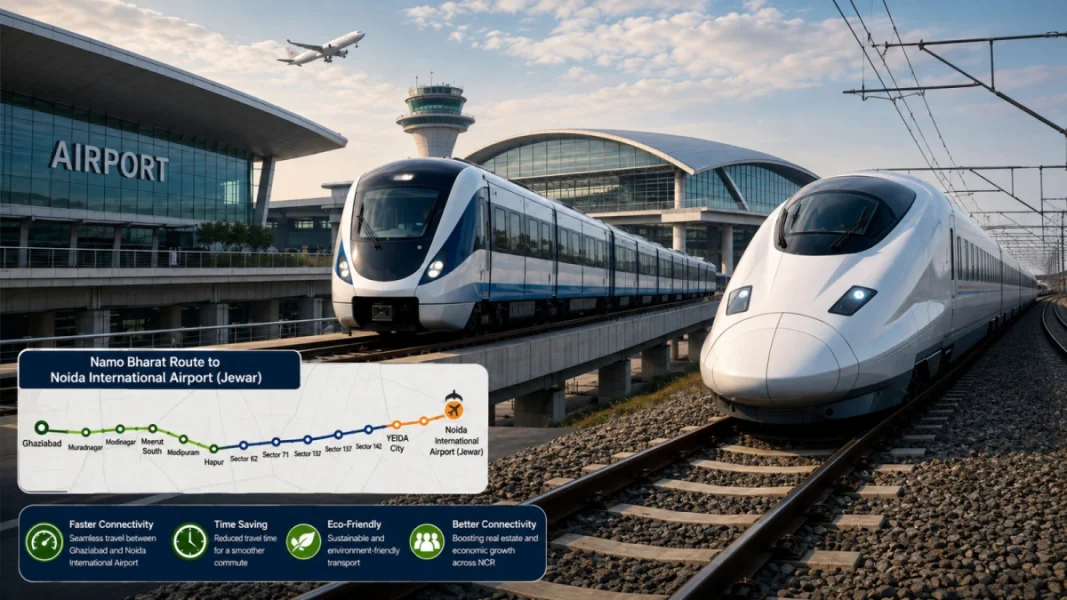
Noida is already one of the key players in the real estate market in the NCR, owning to excellent road, metro, and expressway connectivity. The upcoming Namo Bharat Metro project from Ghaziabad to Noida Airport would make Noida even more favourable for residents as well as commercial purposes. Infrastructure has always been a significant component of real estate development, and better connectivity helps in improving accessibility and other parameters.
Namo Bharat (RRTS) Corridor is anticipated to increase connectivity to important NCR locations such as Ghaziabad, Noida, Greater Noida, and Noida International Airport at Jewar. This improved airport connectivity may affect demand for residences, business ventures, leasing, and property investments in Noida. In this article, we will discuss the connection between Namo Bharat and Noida Airport and its possible effect on Noida real estate.
Namo Bharat Metro Project Latest Update
The Namo Bharat metro runs through the regional rapid transit system of India run by the National Capital Region Transport Corporation. It is a semi high speed train network whose objective is to link major urban cities through the NCR region. The rail transport system has been planned in such a way that it can reach up to Noida International Airport at Jewar running at a speed of 160-180km/h.
Current Status Of The Project DPR Stage
Detailed Project Report (DPR) at Preliminary Level for the Ghaziabad to Jewar Corridor has been completed by NCRTC. Approval Status: Project is at an advanced stage of approval with state authorities and government institutions.
Timeline
Although construction work is still pending its approvals and tender process, the timeline for the project predicts that it will be completed by 2030.
Proposed connection with Noida International Airport
The fast rail route will directly end at the Ground Transportation Center (GTC) adjacent to Terminal 1 of the Noida International Airport. Such connectivity enables air travelers to get connected to Delhi, Ghaziabad, and Meerut via high-speed rail service from the airport.
Namo Bharat Route and Noida Connectivity
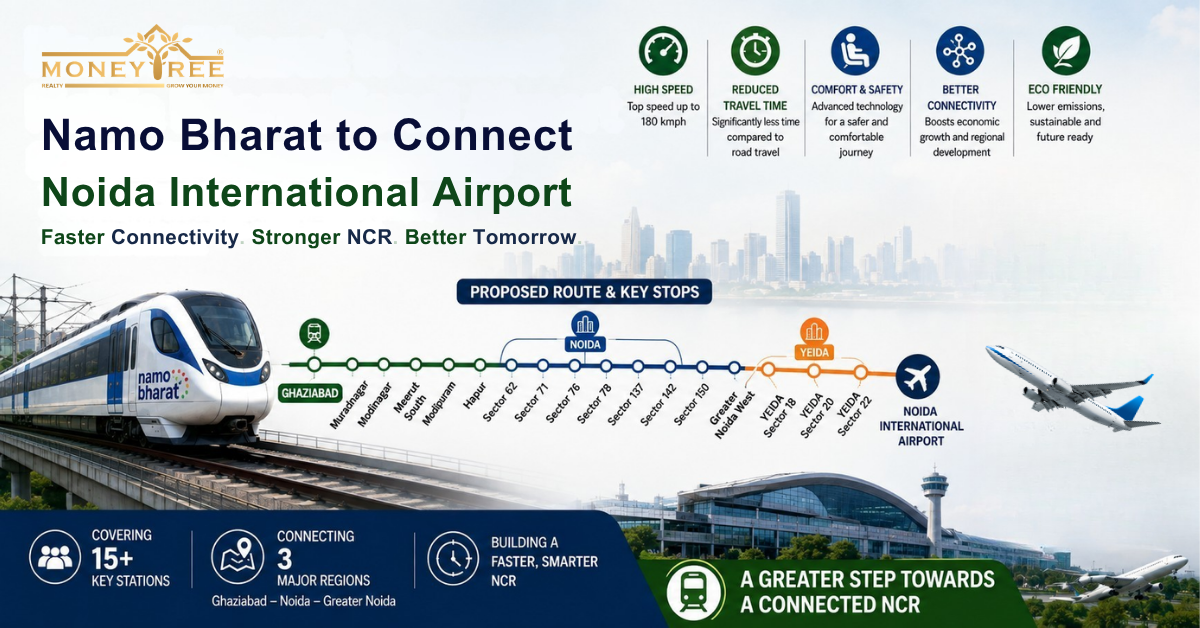
The total length of the proposed road is about 72.44 km.
Key Noida and Greater Noida locations
The corridor will have about 22 to 23 stations, with the running of trains on the lines of the Namo Bharat Express and metro trains on the same lines.
The important stations in the planned route are:
Connectivity With Existing Metro and Roads
How Namo Bharat Could Improve Noida Airport Connectivity
Estimated Travel Time Via Namo Bharat
| Origin/ Destination | Travel Time |
| Ghaziabad to Airport | ~50 Minutes |
| Delhi (Sarai Kale Khan) | ~70 Minutes |
| Delhi Aerocity | ~80 Minutes |
Enhanced Regional Connectivity
Travel may be disrupted due to road traffic congestion on the Noida-Greater Noida Expressway during peak hours. The transit service through the Namo Bharat Noida Airport travels at an average speed far higher than that of regular metro trains.
Access to Airport
For frequent travellers, airport employees, airline workers, and logistics people have the facility to utilise a transit system, which will avoid congested roads. Travel from regional hubs to Jewar will become faster and more reliable.
Improved Connectivity of Noida/Greater Noida and Business Hubs
The transit facility connects Noida/Greater Noida to important business centres in the NCR. This will enable professionals to travel easily from one end to another, and thus make the eastern NCR a unified urban complex.
Impact of Namo Bharat on Noida Real Estate
The proposed 72.44-kilometer Ghaziabad-Jewar Airport corridor is completely transforming the property market of Noida, Greater Noida, and the Yamuna Expressway.
Residential Demand
With the improvement in commuting due to direct connectivity between the Namo Bharat corridor and Noida Airport, buyers are now focusing on locations which are further down on the expressway than those which were earlier perceived as too far from the center of the NCR region.
Property Values
Infrastructure development tends to lead to an increase in property values. Land and apartments of multi-story buildings situated 2-5 kilometers away from Namo Bharat stations are expected to see an increase in their prices with further increases coming during the construction process.
Rental Housing Demand
Development of thousands of jobs in Jewar Airport, YEIDA manufacturing area, and Greater Noida West is expected to increase the demand for rental housing with young professionals and airport employees showing preference for living near transit stations.
Commercial Real Estate
High connectivity makes Yamuna Expressway and Greater Noida West a suitable place to locate corporate offices, IT parks, warehouses, and retail complexes.
Investor Interest
The focus of medium- to long-term investors in properties along the proposed RRTS line is aimed at achieving high rental income as well as seeing their properties' value grow with the start of operations.
Which Areas of Noida Could Benefit?
Although the route from Namo Bharat to Noida Airport passes through some parts of Greater Noida West, Knowledge Park, and Yamuna Expressway, there will be several sectors of Noida that will benefit greatly because of the feeder lines and Aqua Line:
Sector 62
An important business and IT centre in Noida, which will enjoy good traffic flow along with convenient metro connectivity to the Ghaziabad RRTS junction.
Sectors 71 and 76 to 78
Residential sectors which are well developed and densely populated in Central Noida. Being located near the Sector 51/52 metro junction, the people of these sectors will have good access to the regional transport system through feeders.
Sectors 137 & 142
These sectors form part of the most important residential and commercial zones on the Noida-Greater Noida Expressway. The future extension of Aqua Line means that Sector 142 will be developed into a transit point providing connectivity to both Delhi and Jewar Airport.
Sector 150
This sector falls on the outskirts of Noida close to the Yamuna Expressway intersection and is being developed as a ‘green sector’ owing to its low-density development. Since it is close to the Knowledge Park and Pari Chowk RRTS stations, it is a wonderful option for luxury consumers.
Greater Noida West & YEIDA Sectors (Sectors 18, 20 & 21)
These sectors are excellently positioned in proximity to the Namo Bharat line. They are capable of growing into big urban clusters.
Namo Bharat and Noida's Commercial Real Estate Growth
The planned 72.44 km Namo Bharat RRTS corridor from Ghaziabad to Jewar is turning the Noida region into a huge economic powerhouse by linking it with the Noida International Airport. This links up the connectivity gap between west Uttar Pradesh, Delhi, and the airport, and a corporate-retail property boom is on the cards along this route.
Office Demand
Companies from across the globe that operate in India give priority to connectivity for their staff members. The direct and speedy connection between the twin cities of Delhi and Ghaziabad and the commercial centres of Noida and Greater Noida makes the area a more feasible option than Gurugram and Central Delhi.
Retail and Mixed-Use Developments
TOD around the Namo Bharat stations will help drive the development of many shopping malls, high street retail, multiplexes and mixed-use projects.
Business Connectivity
Business executives arriving in Noida International Airport will find the route very fast to reach office parks of Noida or Greater Noida in less than 30-40 minutes without any difficulty of traffic and taxi.
Employment Opportunities
Commercial offices, airway business and retail developments in this corridor will offer job opportunities in the thousands.
Will Namo Bharat Increase Property Prices in Noida?
Yes, the Namo Bharat RRTS corridor will definitely result in an increase in real estate prices in Noida, Greater Noida, and the Yamuna Expressway area as well. The Namo Bharat RRTS corridor connects the Delhi-NCR rail network directly to the Noida International Airport, making this speculative area a prime location for living and business.
Here is how the infrastructure development project is causing increases in real estate prices:
Drivers of Price Increase
Speculative Price Increases for Land: The areas that fall directly along the route, particularly Yamuna Expressway Sectors 17, 18, and 20, are experiencing high investor interest, particularly for residential plots.
The 20-Minute Premium
Properties located within a range of 10-15 minutes from the identified Namo Bharat stations have a value premium of 15%-25% more than those that do not belong to stations.
Transit-Oriented Development Regulations
The TOD policy of Uttar Pradesh allows for increased FAR (Floor Area Ratio) at stations. This facilitates the construction of luxury high-rise buildings and commercial establishments, thus increasing the base value of properties.
Rental Yield Boost
The smooth connection to the airport will bring in a massive workforce (aviation, logistics, tech). This demand will sharply increase rental yields for studio apartments and 2BHKs in hubs like Knowledge Park and Greater Noida West.
Ground Reality Check
While plot and land prices have skyrocketed based on future potential, built-up apartments and flats are appreciating at a more gradual, sustainable pace (12–18% annually). This gap exists because actual residential move-ins will peak closer to the operational launch of the transit corridor and the airport.
Should You Invest in Noida Real Estate Before Namo Bharat Connectivity?
Yes, you should buy property in Noida, Greater Noida, and Ghaziabad before the Namo Bharat link is up and running, but you need to do so very carefully.
Investing early in a corridor benefiting from Noida Airport Namo Bharat connectivity can yield favourable entry prices, but thorough due diligence remains essential:
Location and Connectors: Rather than spend money developing the insides of undeveloped land, one should rather spend their money on developing land that is situated at a distance of 10-15 minutes from the planned points of transit.
Status of Project under RERA: Make sure that the project is registered with UP-RERA and is following the construction timeline.
Credibility of the Developer: Make sure that the developer is credible enough to complete his project in time.
Potential to Rent and Re-sell: Look for availability of nearby facilities such as educational institutes, healthcare services, and markets for easy rent of your property.
Timeline for Infrastructure: Keep your expectations in line with realistic project timelines (beyond 2030).
Namo Bharat vs Noida Metro : What Is The Difference ?
Understanding the different responsibilities of the transit system in Namo Bharat Noida Airport and the Noida Metro (Aqua Line) will enable prospective buyers to select their locations wisely:
| Feature | Namo Bharat (RRTS) | Noida Metro(Aqua Line) |
| Primary Purpose | Regional high-speed connectivity across NCR cities | Local intra-city transit within Noida & Greater Noida |
| Top Operational Speed | Up to 160–180 km/h | Up to 80 km/h (Average ~35–45 km/h) |
| Station Distance | Spaced further apart (5–10 km) for longer regional trips | Closely spaced (1–2 km) for local commutes |
| Coverage | Inter-city: Ghaziabad, Delhi, Meerut, Jewar Airport | Intra-city: Connecting Central Noida to Greater Noida |
| Buyer Relevance | Best for long-distance commuters & airport accessibility | Best for daily local office goers & neighborhood travel |
Conclusion
The suggested connectivity of Ghaziabad to Noida Airport is definitely a step towards better transit in the region and future development of the area. Improved connectivity between Noida, Greater Noida, and the Noida International Airport would be beneficial for the residential, commercial, and real estate growth of the area.
For the buyers and long-term investors, the developing corridor has the possibilities of capital appreciation as well as increased rental demand. Nevertheless, one should consider the location, connectivity, RERA clearance, credibility of the developer, and fundamentals of the project while making the purchase decision. The long-term perspective of the investment would be helpful for the buyer as well.
If you are planning to buy property in Noida or want to invest in properties that will benefit from the infrastructure projects coming up in the near future, MoneyTree Realty, which is one of India's most trusted real estate advisors, can provide you with relevant options.
Frequently Asked Questions