






Table of Contents
Recently, the name GD Naidu (Gopalswamy Doraiswamy Naidu) has become a topic of conversation among everybody. The reason behind the discussion about the name of G.D. Naidu is the release of his biopic, named GD Naidu', which will hit the big screens on 7th August 2026. R Madhavan features as the leading actor in the film. Hence, we have decided to inform you about the name of Gopalswamy Doraiswamy Naidu, better known as GD Naidu, as he is a visionary and important pioneer in modernising South India. He is often referred to as the Edison of India."
Though the film emphasises the struggle and inventions of G.D. Naidu, his impact on the ground can still be seen till date. The G.D. Naidu's contribution to Coimbatore industrial growth was instrumental in paving the way for the development of the city. Industrial development is the main driver of urban development, employment generation and an increase in land values.
Early Life of G.D. Naidu in Coimbatore
G.D. Naidu was born in the year 1893 and was brought up in an agricultural family in Coimbatore. Although G.D. Naidu did not have any engineering qualifications, he possessed an incredible aptitude for understanding machines and mechanics.
In the early days of his career, he took up odd jobs to earn money and purchased his first motorcycle. This quest for learning made him set out on the path of entrepreneurship. Not long after, he entered the field of public transport and started Universal Motor Services (UMS) in Coimbatore. From just one bus, he created a highly dependable and efficient transport system in that area.
How G.D. Naidu Started Coimbatore's Industrial Transformation
Before G.D Naidu's efforts, Coimbatore was mostly recognised as an agricultural area with a basic level of cultivation. Naidu understood that future economic development could be achieved through developing manufacturing industries and transportation.
He improved the existing transportation services by setting up Universal Motor Services and thus making it possible for people and cargo to travel between different towns. Understanding the dependence of India on imported machinery, he created workshops that would manufacture spare parts locally. Through his actions, he showed that Indian workshops were capable of producing reliable things.
G.D. Naidu’s Contribution to Engineering and Manufacturing
Naidu thought that being self-reliant was necessary for being economically independent. The engineer concentrated his efforts on building goods that would meet people's requirements.
Role of National Electric Works in Coimbatore’s Growth
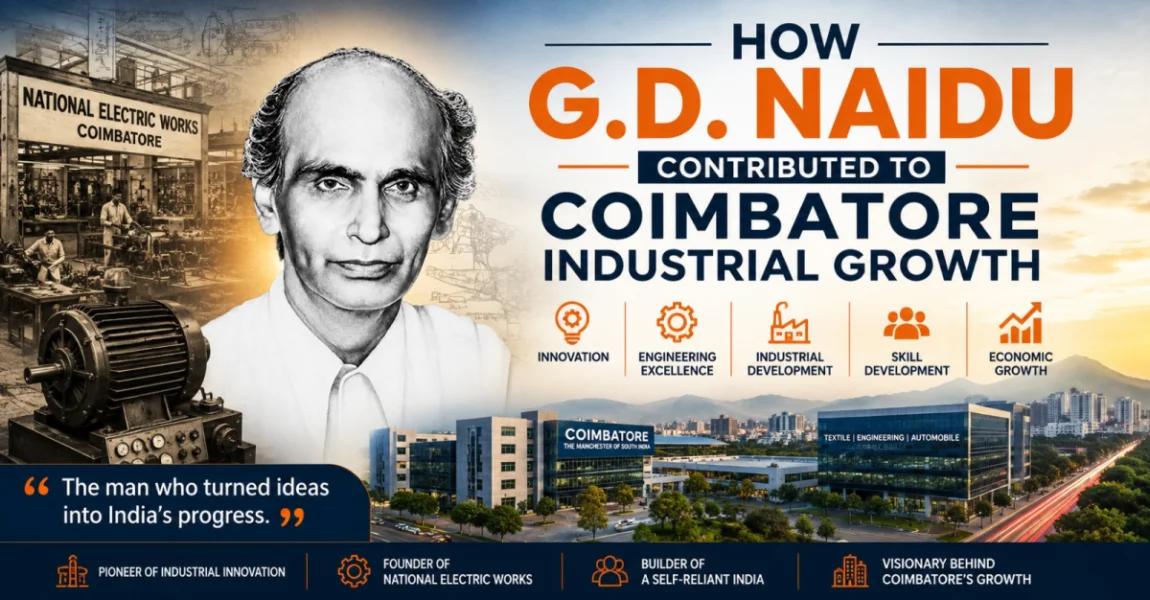
G.D. Naidu founded the National Electric Works in Coimbatore to expand his engineering ventures. The establishment acted as a centre for the manufacture and testing of electrical machinery.
National Electric Works revolutionised the local economy through the provision of cheap motors and machinery to textile mills, foundries, and agricultural farms. With local access to electrical machinery, the development of the textile industry and pump manufacturing industries was boosted, giving Coimbatore its name as the Pump City of India.
G.D. Naidu and the Growth of Skilled Workforce
G.D. Naidu realised that the development of industry would require a skilled labour force. He emphasised skill development through practical training as opposed to learning from classroom theories.
He set up training centers and polytechnics in Coimbatore, where the youth were exposed to machine rooms. He motivated youth to play around with tools, disassemble machines and correct mistakes made. His emphasis on vocational training provided him with a continuous stream of skilled technicians and machinists.
His Contribution to Innovation and Research
G.D. Naidu’s methodology of innovation and research was founded on the concepts of self-reliance and practicality. As opposed to engaging in theoretical scientific work, Naidu was more concerned with dealing with the socio-economic problems facing India during the twentieth century. Through his research, which broke the monopoly held by the West on machinery and agricultural matters, he made an impact on everyday Indians.
1. Agricultural Research
G.D. Naidu changed the Indian agricultural scene completely by considering agriculture an exact science. He was the first person to introduce advanced methods of plant breeding and use growth hormones to fight the problem of hunger. One of his best inventions is "G.D. Cotton," which consisted of long-fibred cotton and had amazing yield capacity, thus helping the Indian textile industry flourish. He gained fame all over the world due to his expertise in botanical gigantism, as he managed to grow highly productive sugarcane and gigantic papayas.
2. Electrical and Mechanical Engineering
During the colonial period, Naidu actively resisted India’s high dependence on costly foreign-made machinery by designing indigenous versions. He reverse-engineered foreign German-made parts to design India’s first homemade electric motor, making Coimbatore the world’s centre of pump making.
Throughout his life, he designed numerous patents for robust and practical mechanical devices. The most famous one was the “Rasant” electric razor, which was a vibrating razor that ran without any internal motor. He also designed distance regulators for motion picture cameras, automatic fruit juicers, and fans running on kerosene for remote areas.
3. Affordable Technology
Naidu was convinced that technology of high caliber must benefit the masses and not be a luxury for rich companies. He was one of the earliest proponents of frugal engineering who intentionally simplified industrial design so that it cut down the cost of the product on the retail level.
While creating consumer products such as radios, calculators and tape recorders, he used inexpensive local mica capacitors and carbon resistors instead of costly imported components. Being totally indifferent towards his own gain, Naidu never took any interest in commercialising his own patents. He often distributed the blueprints for free in order to make automated devices affordable to common workers.
How G.D. Naidu Influenced Coimbatore’s Entrepreneurial Culture
The best legacy of G.D. Naidu is creating a culture of innovation and entrepreneurship in Coimbatore.
Through his success, he convinced local technicians that it is possible to have successful businesses without having foreign education or large amounts of money. The inspiration of G.D. Naidu encouraged many local technicians and labourers to quit their jobs in factories and establish their own small-scale foundry shops, machine workshops, and repair workshops.
G.D. Naidu’s Legacy in Modern Coimbatore
The development of Coimbatore from an agricultural township to being called “the Pump City of India” and an industrial giant is a clear example of how G.D. Naidu’s dream came true. Through the development of a strong culture of manufacturing and technical skills, he developed an economic system that made it easy for future generations to adopt new technologies.
The invention of India's first indigenous electric motor by G.D. Naidu set off a huge domino effect that influenced Coimbatore’s current economic status. Currently, Coimbatore produces more than 40 per cent of all industrial pumps and motors of India, along with almost the whole production of wet grinders used in Indian homes.
This huge production is enabled by thousands of MSMEs (Micro, Small & Medium Enterprises) engaged in foundry operations, precision toolmaking, and automotive parts manufacturing. The early efforts of Naidu to decentralise knowledge about the industry guaranteed that manufacturing is carried out not by a few large companies, but by thousands of small and flexible workshops.
The age-old tradition of engineering education created by Naidu through hands-on polytechnics enabled Coimbatore to seamlessly move on to high-tech domains such as IT, SEZs, and aerospace components. The reason behind choosing Coimbatore by some global tech companies and auto-research centers is that the people in Coimbatore have an innate sense of mechanics and systems thinking.
Moreover, the city’s world-renowned technical institutions and engineering colleges owe their success to Naidu’s “learn-by-doing” approach, which has led to making Coimbatore a knowledge center with engineering experts being exported all over the world.
How Industrial Growth Shaped Coimbatore’s Real Estate Market
The growth of industry due to engineering and manufacturing has been one of the primary reasons behind the evolution of Coimbatore’s real estate market. The growth of industry has had a direct impact on the development of the city through factors such as housing needs due to employment opportunities and the development of commercial real estate.
What G.D. Naidu's Legacy Means For Coimbatore's Future Growth
Coimbatore is still growing as a favoured destination for manufacturing and services. Industrial corridors, ring roads and smart city facilities have accelerated urbanisation in Coimbatore much faster. With the emergence of new manufacturing hubs and technology parks in Coimbatore, there is an increase in demand for luxury housing and commercial real estate. People who are interested in making a profit on their money invest in real estate in areas that have industrial bases, such as Coimbatore.
Conclusion
G.D. Naidu is not only an inventor but also a pioneer who has played a part in making Coimbatore an industrialised place. He is a person who lived during the era when the place was more famous for its agriculture than anything else.
With the expansion of industries, there was a rise in business enterprises as well as skilled labour, resulting in increased demand for commercial property, including offices, residential houses, retail establishments and many others. Commercial real estate in Coimbatore remains an area that is still being affected by this development.
MoneyTree Realty assists investors with the exploration of their property options within India’s expanding urban cities. Be it industrial space, commercial property or retail property in Coimbatore that you need, our company will be able to assist you in making your decision.
Contact us at +91-9732300007 to explore property investment opportunities in high-growth commercial hubs. We are India's most trusted Real Estate advisor.
Frequently Asked Questions