



Table of Contents
The residential areas in Pune are developing far beyond the existing neighbourhoods in the city. With a lack of available land and increasing land costs in core areas, future residential projects will be developed in areas with closer access to job centres, expressways, metros, and future infrastructure.
This trend is bringing about new residential corridors in the city of Pune which are drawing both house purchasers and property developers. Locations situated close to key IT centres and employment areas like Hinjawadi, Kharadi, and the east and west growth corridors have gained due to the enhancement of connectivity and social amenities in their environs. The new transport and urban developments will shape the future of such locations.
For buyers of property, there is much more in terms of a variety of layouts and new housing schemes available compared to established localities. For the investor community, on the other hand, there is growing interest in upcoming residential localities in Pune that have the potential to see further infrastructural development and job creation.
In the current article, we have tried to focus on the residential corridors of Pune, which will play an important role in future development. We discuss connectivity, infrastructure, job centres, residential demand, trends in the real estate market, and forthcoming projects to find out about the emerging real estate areas of Pune.
What Is a Residential Growth Corridor?
A residential growth corridor refers to a geographical belt along key transportation routes (expressways, MRTS, NMRC) that connects employment centers with peripheral agrarian lands. Unlike radial growth patterns, modern Pune is witnessing linear expansion along these transportation routes with suburban commuters accessing jobs with ease.
Difference Between an Established Locality and an Emerging Corridor
Established Localities: Aundh, Kalyani Nagar, Viman Nagar. Benefits: Established social infrastructure.
Drawbacks: Limited land availability, high cost per square feet, heritage buildings and traffic congestion.
Emerging Corridors: Mahalunge, Punawale, Wagholi. Benefits: Large land banks, modern master-planning, superior endowments.
Drawbacks: Some civic infrastructure gaps, value appreciation potential over 5+ years.
Key Factors That Indicate Future Residential Growth
Not all developing areas develop into a success in the housing market. Generally, the most promising emerging corridors demonstrate a combination of investment in infrastructure, employment expansion, urban development plans, and developer interest. The following are some of the elements that can be used to spot promising residential areas.
Top Emerging Residential Corridors in Pune to Watch
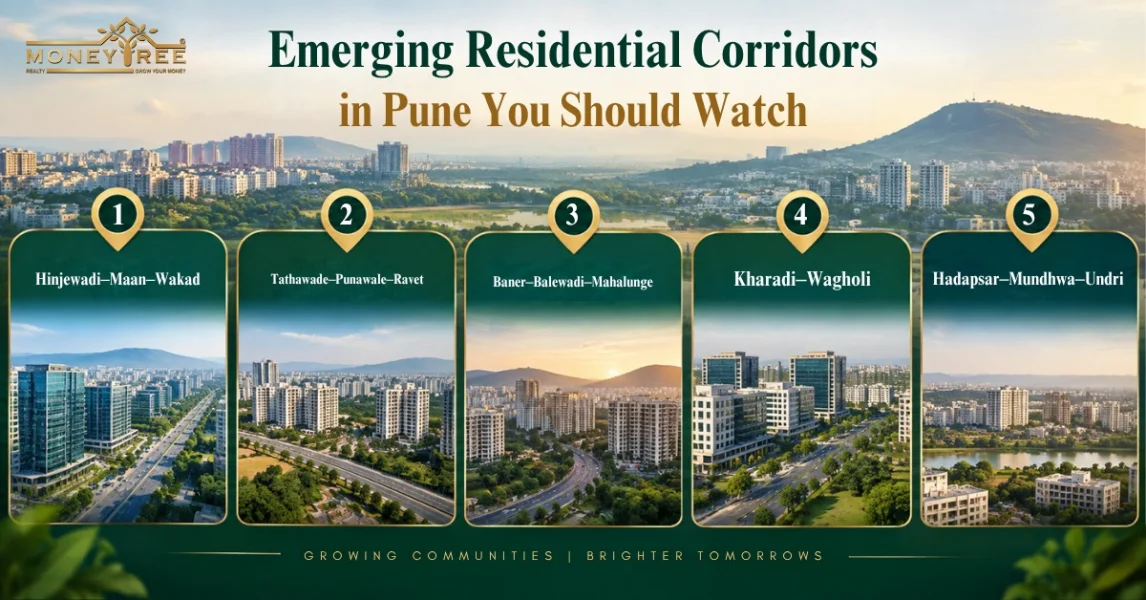
The Pune residential real estate market is growing outside of its conventional areas with help from infrastructure improvements, employment zones, and connectivity, while new locations including Hinjewadi–Maan–Wakad, Baner–Balewadi, and Kharadi-Wagholi are becoming increasingly popular due to a blend of both residential and social amenities, along with access to commercial zones.
1. Hinjewadi–Maan–Wakad
The Hinjewadi-Maan-Wakad belt continues to be the economic nerve center of Western Pune. With Rajiv Gandhi Infotech Park housing over 300 IT/ITeS firms and 400,000+ professionals, this corridor witnesses steady demand for residential plots.
The imminent Metro line 3 (Hinjewadi-Shivajinagar via Megapolis) will further decongest the Hinjewadi-Wakad bridge route. Maan, which has evolved as an extension of Hinjewadi Phase 3, has modern township projects with high-rise configurations for IT professionals.
2. Tathawade–Punawale–Ravet
This belt runs along the Mumbai-Pune expressway and NH-48 highway. As an extension of PCMC, this corridor has wide sector roads, water supply provisions, and strategic proximity to Hinjewadi IT park and PCMC industries.
Punawale and Ravet are preferred by budget buyers seeking larger 2 BHK and 3 BHK apartments at prices lower than Wakad/Baner. Well-established schools like Indira National School and Lotus Business School also add to buyer appeal.
3. Baner–Balewadi–Mahalunge
While Baner and Balewadi have evolved as premium residential localities, the Mahalunge micro-market is an emerging corridor that connects Baner’s lifestyle district with Hinjewadi’s IT cluster.
This area appeals to luxury buyers seeking high-end amenities and retail options. The proximity to Balewadi Sports Complex and the upcoming DP roads towards Mumbai-Bengaluru Highway make it a value-adding proposition.
4. Kharadi–Wagholi
Kharadi, with its EON IT Park, WTC Pune, and Zensar Knowledge Park, has triggered residential development along the Pune-Ahmednagar highway into Wagholi.
While Kharadi commands premium prices for luxury apartments, Wagholi offers affordable housing options. The improvement in bus rapid transit system (Nagar Road BRTS) and proposed Metro extensions make this a compelling choice for emerging real estate areas in Pune.
5. Hadapsar–Mundhwa–Undri
Magarpatta City, SP Infocity, and Amanora township anchor this Hadapsar belt that forms the eastern gateway to Pune. Mundhwa, which serves as a connectivity point between Kharadi and Hadapsar, has modular housing projects.
Undri, located south of NIBM Road, provides affordable residential options ranging from high-density residential apartments to family homes and villas.
6. Charholi–Moshi
The PCMC belt of Charholi and Moshi forms the northern growth corridor of Pune. Located near the Pune-Nashik Highway and Bhosari industrial belt, it has witnessed rapid development due to PCMC infrastructure provisions.
Industrial engineers, auto-component executives, and budget buyers seeking nuclear families housing are the primary beneficiaries of this corridor’s affordability and proximity to the city.
7. Bhugaon–Pirangut–Lavale
This belt, which runs along the Paud Road in western Pune, offers buyers a mix of residential developments. Bhugaon, located between Kothrud and Bavdhan, has scenic development with lake-view residences.
Pirangut, which acts as a logistics corridor between Bhugaon and Lavale, has medium-density housing for IT professionals commuting through the Lavale bypass to Hinjewadi Phase 3.
Notable Residential Projects in Pune’s Emerging Corridors
The table below highlights price ranges, unit configurations, and MahaRERA registration numbers of key projects in Pune’s emerging corridors:
| Project Name | Location | Unit Configurations | Carpet Area Range (Sq. Ft.) | Price Range (Approx.) | MahaRERA Registration No. |
| Life Republic Aros | Hinjewadi Phase 1 / Maan | 2 BHK & 3 BHK | 718 – 1,020 | ₹75 Lakh – ₹1.35* Cr | P52100054550 |
| Gera Joy On Treetop | Hinjewadi Phase 3 | 2 & 3 BHK Duplexes / Apartments | 700 – 1,250 | ₹85 Lakh – ₹1.60 Cr | P52100077635 |
| Shapoorji Joyville Vyomora | Hinjewadi Phase 3 / Maan | 2 BHK & 3 BHK | 685 – 1,150 | ₹85 Lakh – ₹1.45 Cr | PR1260002600999 |
1. Life Republic Aros
Located in the 400+ acre Kolte Patil Life Republic township in Maan-Hinjewadi, Life Republic Aros offers 2 BHK and 3 BHK apartments with modern configurations. This project provides residents with a township experience that includes an operational school, fire station, wide roads, and sports complex.
With its proximity to Hinjewadi Phase 1 and the Metro station, it is ideally suited for IT professionals seeking a well-planned residential community.
2. Gera Joy On Treetop, Hinjewadi
This child-centric residential project in Hinjewadi Phase 3 involves the development of 2 and 3 BHK duplexes and apartments. Unique offerings include multi-level green belts and niche academies focusing on sports, arts, and academics.
Located near IT parks like Tech Mahindra, TCS, and Infosys, it enables an easy commute for tech professionals while providing recreational options for children.
3. Shapoorji Joyville Vyomora Pune
Vyomora is a residential development by Shapoorji Pallonji Real Estate in the Maan-Hinjewadi IT corridor. It involves the construction of multi-story buildings with 2 BHK and 3 BHK units utilizing modern construction techniques.
The project’s emphasis on open spaces, community club house, and a multi-tier security system makes it appealing to buyers focused on developer reputation and project quality.
Infrastructure Driving Pune’s Residential Expansion
The residential development of the city of Pune has started in areas like Wagholi, Hinjewadi, Tathawade, Ravet, Undri, and Kharadi. Improved connectivity, job centres, and new infrastructure have led to increasing demand for properties in Pune.
1. Pune Metro and Its Impact on Housing Demand
The commissioning of MahaMetro Line 1 (Swargate-PCMC), Line 2 (Vanaz-Ramwadi) and the elevated Metro Line 3 (Hinjewadi-Shivajinagar) is transforming commuter behavior. Residential belts witnessing Metro extension announcements command higher rent premiums and faster capital appreciation due to reduced traffic congestion.
2. Pune Ring Road and Peripheral Growth
The proposed 173-km PMRDA Ring Road, intended to decongest city roads by diverting freight traffic to the periphery, will catalyze residential development in Uruli Kanchan, Khedekar, Charholi, Ravet, Pirangut and Shivane. This connectivity corridor creates value for land banks in these emerging real estate areas in Pune.
3. Road Connectivity and Highway Development
The upgrading of Katraj-Dehu Road Bypass (NH-48), completion of the missing link on Mumbai-Pune expressway, and the flyovers on the Nagar Road corridor have improved inter-district connectivity, unlocking residential potential in Pune’s periphery.
4. Employment Hubs and New Commercial Development
The Pune real estate market is witnessing a shift from traditional IT parks to new commercial developments. Emerging grade-A office spaces, flex-desks, and light-industrial parks in Charholi, Chakan, Phaltan road connection, Hadapsar-Mundhwa industrial belt create localized demand for residential housing.
5. Social Infrastructure: Schools, Hospitals, and Retail
The rapid proliferation of international schools (Ruby Park, VIBGYOR, Podar International), multi-specialty hospitals (Manipal Hospital, Sahyadri Hospital) and retail chains (Phoenix Marketcity in Viman Nagar, Phoenix Mall of the Millennium in Wakad) has made these outer corridors self-sustaining residential townships.
Why Are Homebuyers Moving Towards Emerging Areas in Pune?
Buyers looking for property in Pune are more attracted towards developing regions due to reasons like connectivity, availability of infrastructure facilities, cheaper land prices, and proximity to job centers.
How to Choose an Emerging Residential Corridor in Pune
In selecting an emerging residential area in Pune, one should look at connectivity, future infrastructure plans, closeness to workplaces, social facilities, and growth opportunities. This will assist homebuyers in identifying the right property in Pune.
Which Pune Corridors Are Suitable for Different Buyers?
The residential corridors of Pune cater to different requirements. Hinjewadi and Tathawade have appeal among IT professionals whereas Wagholi and Kharadi provide proximity to centers of employment. Ravet and Undri can be considered for individuals looking for affordable properties in Pune.
For First-Time Homebuyers
For IT Professionals
For Families
For Real Estate Investors
For Buyers Looking for Larger Homes
Emerging Residential Corridors in Pune: Key Factors to Check Before Buying
For instance, while searching for emerging residential corridors in Pune, one has to look at things apart from the current prices of the properties. Such things include the connectivity of roads and the metro, schools, hospitals, retail facilities, the rental market, the reliability of the builder, and the appreciation potential of the property.
Conclusion: Pune’s Expanding Residential Landscape
With the increasing demand for housing within the real estate sector in Pune, there are numerous possibilities for buyers. One can make better decisions regarding buying houses by analysing the dynamics of prices versus configuration, RERA disclosures, connectivity, and infrastructure. Choosing the right residential property in Pune is a combination of present needs and future gains.
Moneytree Realty assists home buyers in discovering areas that are on a growth trajectory and residential projects in Pune that have been approved for construction. As India’s most trusted real estate advisory, the professionals at Moneytree Realty assist you in finding a property that suits your needs and budget.
Are you looking for a house in Pune? Get in touch with Moneytree Realty now and schedule an appointment to find out about the approved residential projects in Pune. Contact us at: 9732300007.
Frequently Asked Questions