





Table of Contents
India’s commercial real estate sector is transforming because of the fact that investors are now thinking of moving out of Tier I cities as they are finding better avenues for investments. Cities such as Mumbai, Delhi, Bengaluru, and others have seen an increase in land prices, office rentals, and competition. For this reason, investors and business houses are now moving towards the Tier II cities
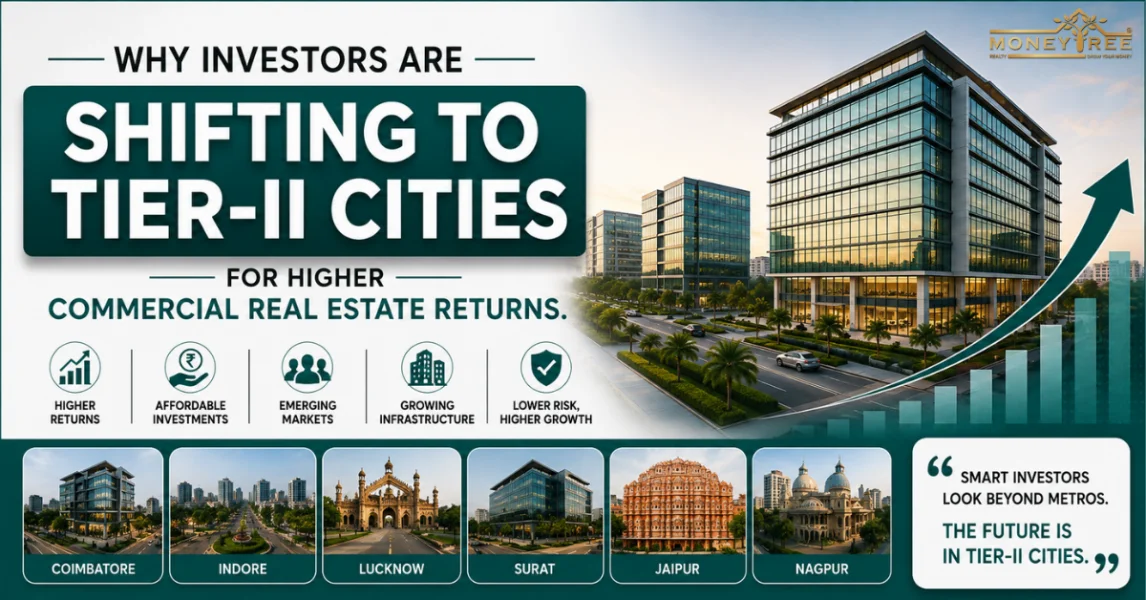
The cities like Jaipur, Lucknow, Indore, Chandigarh, Kochi, and Coimbatore have become favorites among investors in the field of commercial real estate. The reason being that due to better road connectivity, airports, connectivity via the Internet, creation of business, and increased demand among consumers, these cities are witnessing development in offices and shopping complexes.
The primary appeal for investors is the low cost of entry, increasing demand for rentals, and the appreciation of property value in the long run. However, what is behind the growing trend toward Tier-II cities, and which cities provide the best possibilities?
This article will discuss some of the major factors that contribute to the increasing importance of Tier-II commercial real estate in India and will reveal why such emerging cities can become a worthy alternative to Tier-I cities.
What Are Tier-II Cities in India?
The Tier-II cities are upcoming urban areas which are smaller than India’s top metropolitan cities but feature developing infrastructure, economic growth, and increasing business. These cities generally provide cheaper real estate and operational costs in comparison to Tier-I cities but provide access to talent, growing consumer base, and increased connectivity. These elements are making Tier-II cities an attractive destination for businesses and real estate investors.
Comparing Tier-I Cities and Tier-II Cities
The Tier-I cities include Mumbai, Delhi NCR, Bengaluru, Hyderabad, Chennai, and Kolkata. These are already developed economies, having international business operations, well-developed capital markets, and good connectivity. However, there are drawbacks for these cities as well, such as shortage of land, traffic issues, high cost of operations, and low rental returns.
On the other hand, Tier-II cities have low land costs, large commercial footprints, underutilised capacity, and low cost of living. Even though capitalization rates in Tier-I metro cities are often fully capitalised, those in Tier-II cities tend to have relatively lower valuations and higher rental yields.
Commercial Investment Destinations – Tier II
India’s commercial real estate market now reaches far and wide past the boundaries of its main markets. Places like Lucknow, Jaipur, Indore, Coimbatore, Chandigarh, Bhubaneswar, Kochi, Nagpur, Surat, and Visakhapatnam have come up as significant commercial centers. Such cities feature growing tech parks, grade A retail high streets, regional distribution centers, and even co-working spaces.
Why are Tier II Cities Becoming Commercial Real Estate Hotspots?
Tier II cities have emerged as centers of opportunity for commercial real estate investments because of the saturation of established metropolises, forcing companies to look for cheaper land and more profit in fast-growing urban areas.
Reason for development
The first and foremost reason behind the emergence of commercial markets in Tier II cities is the massive amount of infrastructure development that is taking place in the country. The development includes expressways, regional airports through the PM Gati Shakti and UDAN program, metro rail and freight corridors which ensure smooth physical connectivity to regional cities.
IT Parks & Expansion of Business
Technology firms along with banks and business process outsourcing firms (BPO) are currently decentralizing their operations. In order to save on cost of operation and tap new labor sources, such companies have set up office campuses and global capability centers in cities that do not fall in Tier-I cities. The development of IT parks in such cities offers corporate tenants Grade-A floorplate at significantly lower rents compared to the ones in Tier-I cities.
Government Policies
Focused policy initiatives have led to rapid commercial growth in Tier-II cities. Industrial policies of states, single window clearance system, tax incentives for setting up IT/ITeS units, and Smart Cities Mission have improved governance, power supply and IT infrastructure in Tier-II cities.
Start-ups and MSMEs
The Tier-II cities are now entrepreneurial centers and not just consumers of goods and services produced in Tier-I cities. The lower cost structure and presence of local engineering graduates have fostered a start-up culture in such cities. Moreover, the traditional Micro, Small and Medium Enterprises (MSMEs) are changing their format from being an unorganized unit to organized commercial complexes.
Top Reasons Investors Prefer Tier-II Cities
Investors favor Tier-II cities since saturated large metropolises provide fewer returns, whereas Tier-II cities offer reduced entry costs, developing infrastructure, and considerably higher rental yields.
The efficiency of capital is one of the major benefits of the investment in rising commercial markets. The cost of land and capital value of commercial properties in Tier-II regions are usually 30-60% less than in Tier-I metropolitan cities. It means that there is a smaller amount of capital needed for the acquisition of quality commercial properties.
Because of the low rates of property purchase and increased occupier demand in Tier-II regions, rental income is significantly higher. Grade-A commercial office properties in Tier-I metropolitan cities provide rental yield from 6% to 8%, but commercial prime properties in Tier-II cities bring 8.5-11% of net rental income.
The Tier-I cities are highly developed, and therefore the value of their capital appreciates at a steady rate. On the other hand, Tier-II cities are undergoing active infrastructure development stages. An addition of an airport, express road, or an IT park in Tier-II city can lead to double digit capital appreciation within 3 to 5 years' time period.
The institutional players as well as mega funds concentrate on doing big deals in the Tier-I cities. It leaves Tier-II cities much less crowded, allowing for private investors, family offices, as well as regional funds to buy high street retail stores as well as Grade-A offices at decent prices without being in a battle of competitive bids.
The purchasing power in regional urban cities has grown immensely, due to increased disposable income, double-income families, and change in lifestyle preferences. Economic development leads to direct commercial demand for the real estate market in retail, entertainment centers, branch offices of companies, as well as healthcare sectors.
Commercial Real Estate Trends Driving Growth
Growth is being propelled by commercial real estate trends, which are shifting from conventional high-cost office buildings to decentralised and logistics-oriented regional assets that generate high returns on investment.
Office Space Development
The demand for office space from corporate entities in Tier-II cities has graduated beyond unorganised forms of shop-cum-office space. The multinational companies and large corporations in the country now demand state-of-the-art grade-A office complexes fitted with air-conditioning facilities, high-speed elevators, 100% power backup, latest fire fighting arrangements, and green buildings certification.
High Street and Retail Developments
Organised retail has been growing very fast into the regional markets. The traditional markets have been complemented by the open high street retail developments and multi-screen retail malls. The fashion brands of the country, consumer electronics, fine dining restaurants, and entertainment facilities are leasing the high street developments of Tier-II cities.
Warehousing and logistics
With the increase in the use of e-commerce and quick-commerce delivery platforms, as well as third-party logistics (3PL) service providers, tier-II cities have become key supply chain nodes. Road crossroads cities like Nagpur, Indore, and Surat are witnessing a growing demand for advanced, large warehousing facilities as well as cold storage hubs.
Mixed-used developments
There is a growing trend for mixed-used development projects which include the presence of retail stores, boutique offices, serviced studio apartments, and food courts under one project. Mixed-used developments provide multiple streams of rent income along with better footfalls.
Coworking spaces
The adoption of flexible working models has created high demand for coworking spaces in tier-II cities. Coworking players are opting for large floor plates to serve remote corporate teams, regional freelancers, and startups who wish to have an office setup without making large investments.
Top Tier-II Cities for Commercial Real Estate Investment
Investments are being made in select Tier-II cities owing to the fact that these selected regional cities possess all the right elements of good government planning and high-quality infrastructure.
Lucknow
Lucknow has metamorphosed into the finest regional commercial market of North India owing to various huge civic infrastructural developments like Agra-Lucknow Expressway, Purvanchal Expressway, and Lucknow Metro Expansion, among others.
These developments have enabled Lucknow to attract top-class real estate investors. Gomti Nagar & Gomti Nagar Extension are the most popular commercial strips opted by investors of retail and office space in the city.
The most well-known commercial projects in Lucknow are as follows: Shalimar Business District
Jaipur
Jaipur is an important commercial city in the extended economic zone of the National Capital Region. With Mahindra World City, World Trade Park, and a well-supported tourism, handicraft and IT/ITeS industry, Jaipur provides reliable commercial returns on Tonk Road, Jagatpura and Ajmer Road bypass corridors.
Indore
Since it serves as the business capital of Madhya Pradesh, it is said that Indore has a wonderful industrial environment, civic hygiene, and education facilities. The Super Corridor and AB Road have turned out to be commercial centers and there have been many investments in corporate offices, co-working spaces, and retail complexes.
Coimbatore
Referred to as the "Manchester of South India," Coimbatore is believed to possess a diverse economic base functioning through textiles, precision engineering, automobile components, and information technology. Some of the significant commercial strips in Coimbatore include Avinashi Road and Saravanampatti.
Chandigarh
Chandigarh Capital Region, consisting of Chandigarh, Mohali, and Zirakpur, is an advanced commercial market of North India. Due to its per capita income level, good urban infrastructure, and presence of various IT services, healthcare facilities, and brands in retail, this place has become the preferred location for rental yield.
Bhubaneswar
Bhubaneswar has already been established as the IT and educational capital of eastern India. Due to the forward-thinking policies of the state, the city's Infocity and Info Valley areas have been populated by several of the largest IT service providers, creating a consistent requirement for office and retail space.
Kochi
Kochi's commercial market thrives due to its seaborne trading, tourism, and technology parks such as SmartCity Kochi and InfoPark. The high street retail outlets and commercial offices situated in the MG Road, Kakkanad, and NH Bypass regions benefit from significant pedestrian traffic and demand for office space by corporates.
Nagpur
Being centrally located geographically within the Indian subcontinent, Nagpur is turning out to be a premier logistics, warehousing and aviation hub of the country. With the MIHAN (Multi-modal International Cargo Hub and Airport at Nagpur) project and major highway interconnectors, Nagpur can be regarded as an excellent commercial investment destination.
Surat
With its prominence as an international hub for diamond cutting and textile production, Surat is among India’s most affluent commercial cities. The launch of the Surat Diamond Bourse and construction of the Surat Metro project has increased the need for offices and retail complexes on the Hazira and VIP Road stretches.
Visakhapatnam
Visakhapatnam is a vital city on the Eastern Coast with its presence in the industrial sector and ports. With its developing IT infrastructure in the Rushikonda IT Hill and rising petroleum and steel industries, there are several lucrative commercial property options in retail and office formats.
Comparison of Price and Size of Commercial Property
The below-given table lists a selection of commercial projects from our curated list with their investment metrics and prices per unit area:
| Project Name | Location | Developer Name | Property Type | Size Range (Sq. Ft.) | Starting Price (INR) | RERA Registration Number |
| Shalimar Business District | Gomti Nagar Ext., Lucknow | Shalimar Corp Ltd. | Office Spaces & Retail | 450 – 2,500 sq. ft. | On Request | UPRERAPRJ143786/01/2024 |
| AIS The Galleria | Sector 4, Gomti Nagar Ext., Lucknow | AIS Developer LLP | Commercial Shops & Offices | 250 – 1,200 sq. ft. | ₹38.95 Lakhs onwards | UPRERAPRJ418328 |
| Paras Avenue | Sector 129, Noida Expressway | Paras Buildtech | High-Street Commercial | 300 – 1,800 sq. ft. | ₹60 Lakhs onwards | UPRERAPRJ297873 |
| SVG Town Square | Alpha 2, Greater Noida | SVG Group | Retail Shops & Offices | 200 – 1,500 sq. ft. | ₹30 Lakhs onwards | UPRERAPRJ629900 |
| Gera 343 Crest | Kharadi, Pune | Gera Developments | Grade-A Offices & Retail | 500 – 3,000 sq. ft. | On Request | P52100022737 |
Tier-I vs Tier-II Cities: What Yields Better Returns on Investment?
The choice between Tier-I and Tier-II commercial properties is based on the following factors related to the particular investor's financial needs and time horizon for the investment:
Important Things To Consider Before Investing In Commercial Real Estate
The success of commercial property is determined by its location. It should be placed close to important means of transportation such as highways, railway stations, airports, and populated residential areas. A commercial property located in a zone that has growing residential zones will have constant flow of people.
Check for any municipal infrastructure plans that will affect the property before investing in it. This includes roads being widened or flyovers being built in a particular area.
Examine the occupier characteristics of the local market. Is the demand led by tech companies, retail firms, banks, or healthcare providers? Matching your property investment choice with the dominant tenants' demand will enable quick leasing and steady cash flows.
Collaboration with a reputable developer is crucial when operating in the regional market space. Reputable developers provide top-notch building quality, grade A building management, timely delivery, and successful acquisition of national anchor tenants.
Legal provisions must be ensured. It is important to ensure that the commercial property has a valid and up-to-date RERA registration number registered with the concerned state authority. Titles of the land, environmental approvals, building plans approvals, and date of completion must be verified from the official RERA website.
Plan your exit route before investing in the project. Do you intend to own the commercial property for long-term rental earnings, sale to retail investors due to capital appreciation, or group it with other properties to form a large income-generating property portfolio to be resold to institutional investors?
Potential Dangers Involved in Investing in Tier-II Commercial Spaces
Even though the investment growth potential for the most suitable Tier-II cities is very promising, it is important to actively manage micro-market risks in order to ensure maximum gains from such investments:
Best Ways of Maximizing Returns on Commercial Real Estate Investments
Future Outlook: Would the Next Investment Wave Come from Tier-II Cities?
The structural transformation process taking place in regional India guarantees that Tier-II cities will spearhead the next wave of growth in commercial real estate development. With Indian corporates adopting a decentralized operating structure, coupled with regional consumption continuing to grow, the need for high-grade office spaces, retail infrastructure, and organized warehouse facilities is bound to exceed the supply.
In light of the growing interest of REITs (Real Estate Investment Trusts) in evaluating such regions that have highly performing commercial properties, early investors in prime commercial assets in Tier-II cities are poised to earn good capital returns.
How We Facilitates Your Investment into High-Potential Commercial Real Estate
Understanding commercial real estate in different regions needs knowledge about the local real estate market, due diligence and access to institutional quality stock. Once you become our client at MoneyTree Realty, here is how our expert commercial advisory team helps you invest into commercial properties:
Conclusion
Tier-II cities commercial real estate reflect a shift in India’s real estate industry. Property pricing, favourable rent prospects, improved infrastructural facilities, and increasing presence of firms have made cities like Jaipur, Lucknow, Indore, Chandigarh, Kochi, and Coimbatore viable destinations for investments.
But selecting the proper real estate plays a vital role in ensuring high long-term gains. Investors should look into whether there is compliance with RERA and whether they are dealing with reliable developers, and should also consider areas having good connectivity and business activity.
It can be difficult to invest in an emerging market without any local knowledge. With the help of MoneyTree Realty, you will be able to evaluate different commercial properties, identify market trends, confirm project details, and make decisions that suit your investments.
Contact MoneyTree Realty via 91-9732300007 now. We are India's most trusted real estate advisor and help you make informed commercial real estate investments in the booming Tier-II cities of India.
Frequently Asked Questions