






Table of Contents
Introduction
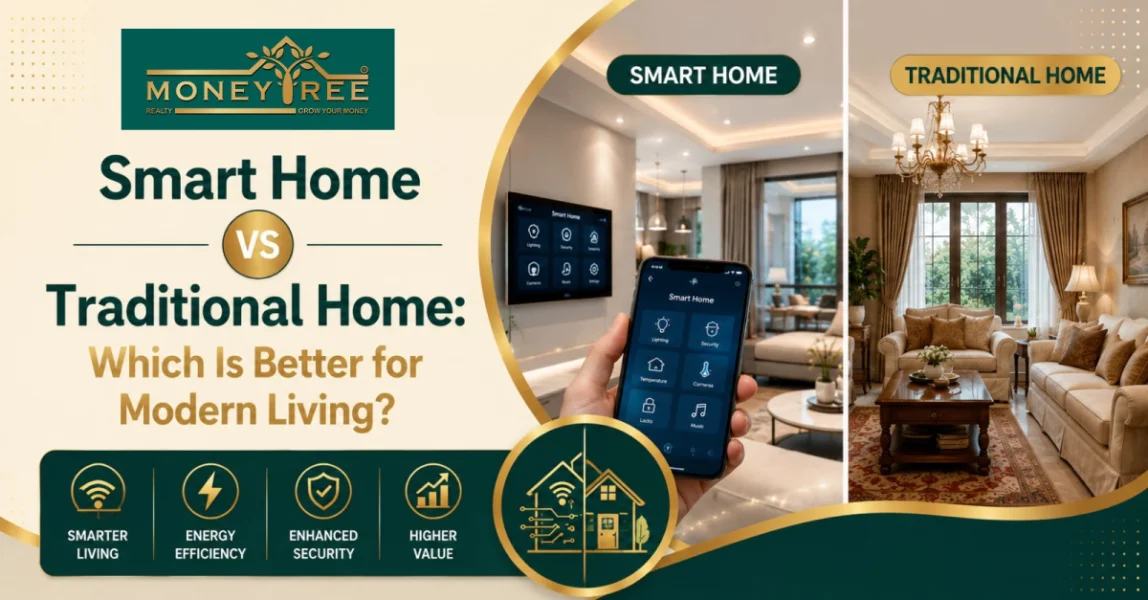
We were approached by one of our clients who had just visited us in our Greater Noida office with two different floor plans – both 3 BHKs with equal carpet areas and ₹8 lakh difference in asking prices. One of them was a typical apartment in a good society while the other was a newly launched flat with full-fledged automation facilities like app controlled lighting, automated CCTV security, and an occupancy based air conditioner. The client asked us the question which is becoming a norm these days, "Is it worth paying extra money for this added facility?"
The following article provides you with the solution to that question. It discusses the pros and cons of smart homes as opposed to traditional houses on the basis of important factors including price, safety, energy efficiency, maintenance, family friendliness and more. This is the information that you should consider before reaching a final decision about the choice between smart home and conventional home.
Understanding Smart Homes
A smart home refers to the home in which there is a connection between the basic functions of lighting, HVAC (Heating Ventilation Air Conditioner), Security system, Door Access, and appliances. This technology is referred to as Internet of Things (IoT) as it entails having the various devices fitted with sensors and internet connectivity capability.
Smart homes range from small installations such as using the Google Nest Thermostat, Ring Video Doorbell, and Philips Hue Smart Bulbs at a price range of about ₹40,000–₹60,000, all the way to having an artificial intelligence-based system built within the construction process at an estimated cost of ₹5 lakh to ₹25 lakh, depending on the size and the level of automation of the property. Some of the companies doing such include Tata Housing (Intellion Park), Godrej Properties and Mahindra Lifespaces who are installing smart homes for sale at places such as Noida, Greater Noida, and Bengaluru.
What differentiates a smart home from one that is simply filled with some smart devices is that they work in tandem with one another. A security system that is able to identify suspicious movement outside of the door will simultaneously turn on the lights, notify the owner through their phone, and secure all entrances.
What Defines a Traditional Home ?
A traditional house refers to a regular residential house that doesn't have any IoT system or any form of automation. Traditional houses have manual operations for all systems, such as light switches installed in a panel, an independent CCTV security system (if there is one), controlled individually by a guard or manually, each air conditioner (AC) with its own remote control, and a mechanical lock and key.
This is not meant as an insult. India has more than 100 million households in urban areas, most of which are traditional houses that work fine. Traditional houses can exist independently without any need for internet connectivity or software upgrades. It will be a huge benefit that comes out when a smart house needs a firmware upgrade to function properly.
This difference exists since the smart house vs traditional house comparison is not supposed to determine which option is better. Instead, it is based on which set of compromises would suit the buyer.
Major Difference Between Smart Homes and Traditional Homes
Here is a direct comparison across the parameters that buyers consistently ask about:
| Parameter | Smart Home | Traditional Home |
| Upfront technology cost | ₹50,000–₹25 lakh+ | Nil to minimal |
| Monthly electricity bills | 15–30% lower (BEE estimates) | Standard consumption |
| Security system | IoT cameras, smart locks, AI alerts | CCTV, manual locks, guard |
| Internet dependency | High — core functions need connectivity | None |
| Remote control capability | Full — app-based anywhere access | None |
| Resale value premium | 5–12% in metro markets (JLL India 2025) | Baseline market rate |
| Maintenance complexity | Requires tech-literate upkeep | Standard civil and electrical |
| Suitable for | Tech-comfortable buyers, investors, families | Budget buyers, rural areas, tech-averse |
The above table is indicative of market trends. The estimated 5-12% resale value advantage for smart homes in metropolitan markets is sourced from the JLL India residential technology premium study (2025) which is specific to urban centers such as Noida, Greater Noida, Mumbai, and Bengaluru, where there is sufficient consumer knowledge about home automation systems to influence pricing.
Advantages of Smart Homes
Advanced Security Features
An automated smart home system provides advanced security features. Unlike a regular CCTV system, a smart home security system sends notifications directly to your mobile phone about the activity that has been recorded. Moreover, such systems, based on Hikvisioin AI cameras, CP Plus smart cameras, or other international brands such as Arlo and Ring, are able to distinguish not only moving objects from non-moving but also identify the moving object as a person or a car, and even perform further actions like lighting up the area, notifying the neighbours, or securing other access points.
Smart locks allow eliminating a physical key completely. Accessing the house becomes possible through a PIN code, fingerprints, an RFID card, or a smartphone signal proximity feature. This means that switching between tenants is easy for rental investors without involving a professional and enables automatic logging of the entry times.
However, there are some limitations to using smart home security systems as they require power supply and internet connection. To avoid this issue, a proper set of the equipment should include a battery and 4G/5G backup SIM card for a smart router, which also entails extra expenses.Energy Efficiency
Here’s where the math is most explicit. According to findings from India's Bureau of Energy Efficiency (BEE) and independently conducted research out of IIT Delhi, advanced HVAC control mechanisms, where the air conditioning is controlled based on the occupancy of the rooms and the surrounding temperatures through sensors, rather than running the system at constant temperatures, can cut down on energy consumption by 18-28% compared to traditional methods. Considering that AC constitutes 40-60% of your electricity bill during summers in North/South India, this becomes a substantial saving.
With smart lighting enabled via LEDs and occupancy sensors, along with scheduling for dimming, Philips Hue estimates a savings of 15-20% on lighting energy consumption. When aggregated across a 2000 square feet apartment in Noida/Greater Noida, homeowners have claimed monthly savings of ₹1,200 to ₹2,800. In ten years, this accumulates to a notable savings on the cost of investing in energy-efficient smart home technologies.
Enhanced Convenience
Smart lighting using voice control, wake-up and bed-time sequences automatically scheduled to run, automatic cooling of your apartment prior to returning from work — such features are truly practical for working families, not mere show-and-tell demos. The greatest demand for convenience features stems from two-income families, traveling couples, and senior family members in multi-generational households who could use some help with lighting controls and remote management.
The Amazon Alexa and Google Home platforms, both available in India, now offer voice control capabilities in Hindi for all main features — unlike in three years' time when these options were inconsistent across Indian languages.
High Property Value
The modern smart homes enjoy significant pricing premiums in metropolitan cities. As per the 2025 residential outlook report by JLL India, smart homes with certified apartments in Tata Intellion Park (Gurugram), Godrej Nurture (Greater Noida), and Prestige Smart City (Bengaluru) have recorded a realization rate of 6-10% above their comparable units per sq ft in the surrounding radius. In the Noida and Greater Noida market, features of smart homes are now becoming standard in the ₹80 lakh and above segments, hence their absence will require price reductions to attract buyers rather than vice versa.
Benefits of smart home investment for investors include the premium value and faster sales pace since smart apartments in Noida and Greater Noida are sold 18-22% faster than regular units of similar value within the same project based on internal transactions by Moneytree Realty.
Better Lifestyle Experience
Apart from the functional aspects, smart homes provide a new feel of living that homebuyers start appreciating once they use it and realize how much they miss it when they shift back to the traditional format. Motorized shades adjusting their positions based on solar intensity, air filters working once the level of PM2.5 particles is detected beyond the pre-set limit, and electric hot water systems that utilize the electricity supplied during low-demand hours; while all these features by themselves may seem negligible, together they make for a qualitatively new feel of living experience. Digital lifestyle apartments are no more limited to high-end markets — they have become available to mid-market buyers in Greater Noida West and Noida Sector 150 at prices starting from ₹75 – ₹90 lakh.
Benefits of Traditional Homes
Lower Initial Cost
Direct benefit. An ordinary apartment having the same carpet area and located in the same locality would be 4-12% cheaper than its smart-enabled counterpart simply on account of there being no technology component involved in the latter. This difference can make a crucial difference when it comes to servicing the EMI for people buying their first property with a tight budget. Under the PMAY scheme for affordable housing, smart-home components will not be included, and rightly so.
Easier Maintenance
Any civil contractor, electrician, or appliance repairman in India will be able to fix a traditional home. The expertise, equipment, and replacement parts are always available. Smart home maintenance, on the other hand, demands either the warranty provided by the manufacturer (and that costs anywhere between ₹8,000 to ₹25,000 per year), or a technically knowledgeable home owner willing to update firmware and configure networks. The upkeep of a traditional home is simply more straightforward, and this becomes even more pronounced with age and the obsolescence of devices.
No Internet Dependancy
A power outage in a typical house means a nuisance. In a smart home, where there is reliance on the internet for controlling everything, a power outage implies that the lights won't come on, the locks default to a secure but difficult position, and cameras stop working. This problem can be addressed in a well-designed smart home using local computation, power backups, and fallback control through the LAN. This approach increases costs but also solves the problem.
Simplicity and Familiarity
For families where everyone cannot be technologically adept — senior parents, domestic workers controlling the house while everyone is away at work, and kids — there is no need to learn anything new for conventional houses. A regular switch, a mechanical lock, and a CCTV remote that works on its own are easy to use. This becomes particularly important for joint Indian families where the de facto head of the family may not be the technologically savvy purchaser.
Cost Comparison Between Smart and Traditional Homes
Smart Home Costs
The installation costs of smart homes in India vary widely. To help conceptualize, it can be categorized as follows:
Apart from that, the maintenance cost of the smart home involves technology upgrade cycles as well. These devices last for 5-8 years until a new purchase is needed, which often gets overlooked in developer brochures.
Traditional Home Costs
The costs associated with a conventional house are much more stable: regular civil and electrical repairs, no software fees, and no service agreements with manufacturers. Initial savings achieved through the reduced technology investment will continue to pay off throughout the life of the property, although they will be somewhat reduced by higher electricity payments (no smart power usage) and by potentially slower re-sale rates than those of smart homes.
The realist analysis: for those intending to own a property for more than 7 years within a metropolitan area, it would be reasonable to assume that initial technology expenditures will be compensated for by energy savings and re-sale benefits. In all other cases, a cheaper and easier-to-maintain conventional option seems like a better decision.
Security Features Comparison
Smart Home Security
Smartest systems for home security that would be installed in the residential real estate sector by 2026 include AI-empowered camera (Hikvision DS-2CD series, CP Plus CPSC cameras), biometrics, and smartphone-activated smart locks (Godrej PIVOT, Samsung SHS series), video door bell, and motion sensor integrated with a centralized alarm system. Some elite smart housing societies of Noida and Greater Noida have even introduced perimetre sensors and panic button integration with the society security command center, which is a leap from installing a single CCTV camera at the guard post.
Unlike manual security, smart home security runs 24/7 without being influenced by any fatigue or distraction on part of human security guards. Smart home security data log can be recorded, searched for a particular timestamp, and used as evidence in court proceedings.
Traditional Home Security
The traditional form of gated community security, which includes security staff, surveillance cameras at the point of entry/exits, mechanical locks, and intercom systems, works well enough for all its members. However, the difference between such a security system and a smart one lies in the speed of response and the ability to monitor remotely. It is impossible to know if the door of your traditional house is closed when you are at the airport, and any event after working hours can be viewed only through recorded videos on the security camera.
Energy Efficiency and Sustainability
Energy efficiency serves as the most tangible quantifiable benefit of a smart home. The BEE’s 2025 Annual Report on residential energy consumption in India highlighted that the use of IoT-powered HVAC and lighting systems in monitored residences was found to consume 19–26% less power than non-smart residences having comparable occupancy levels. For an average-sized apartment in Noida or Greater Noida using 1.5 ton and 2 ton ACs during a six-month long summer season, this amounts to saving ₹14,000–₹22,000 in electricity charges annually according to present UPPCL tariffs.
On a wider scale, green buildings featuring smart energy management play a crucial role in achieving India's national targets for grid-level efficiency. According to IGBC's Green Homes certification criteria, which presently include more than 6,000 residential projects across India, smart energy management forms one of the most vital scoring factors. Projects such as Godrej Nurture in Greater Noida and Tata New Haven in Bengaluru have been IGBC-certified on account of their smart energy features.
It is not correct to say that all old buildings are wasteful from an energy standpoint; there is no doubt that a conventional home with proper insulation and design and 5-star-rated appliances can score well enough when it comes to energy performance. However, what makes the smart home stand out is its automatic optimization system.
Comfort and Convenience Factor
The case for convenience and ease of use in modern smart homes applies to three key buyers:
A key factor in achieving maximum convenience is the design of the app interface. At present, the smart home landscape in India remains disjointed, with no seamless communication possible among Google Home, Amazon Alexa, Apple HomeKit, and developer apps. Prospective homeowners planning a fully-automated smart home must ensure system compatibility with their preferred ecosystem. A high-end smart home development promising an exclusive app for three years' software support is not convenient but risky.
In terms of traditional houses, the level of comfort is totally dependent on the structural integrity, the nature of ventilation, and the kind of appliances used, aspects which can easily be assessed. It is argued that traditional houses may in fact be easier for residents to feel comfortable within since there are no technological systems to manage, unlike smart homes.
Maintenance and Long Term Value
In maintenance and longevity, the difference between smart and traditional home appliances becomes the most pronounced. For smart homes, specifically the IoT sensors, smart locks, and proprietary home management system, there is an average lifespan of 5-8 years until performance degradation and unavailability of spare parts occurs. The developers of houses equipped with smart technology built in 2016-2018 currently experience situations in which technology obsolescence comes about, whereas the house itself still can be utilized in 50+ years.
It is a serious concern. If considering purchasing a smart home in India, it is best to inquire from the developer about two key things: which smart home technology is used and how long is the warranty of the manufacturer for its performance. The answer reveals whether you are purchasing a future-proof smart home or one that needs a total replacement of technology in seven years.
On the other hand, traditional houses have a virtually limitless system for maintaining them. Indian trade skills related to civil and electrical matters are plentiful, standardized, and will never be outdated. Traditional flats are also very easy to sell because there is plenty of understanding about their resale value. However, this value grows much slower than that of smart homes.
Which Home Type is Better for Families ?
Families, especially families with children, elders, or both, require a different answer to the question, and the answer would depend on whether the decision-making regarding the smart home is being done from the children's end or the parents'.
Families with parents familiar with tech devices and children enrolled in schools are always found to be happy with all three functions offered by the smart home, viz., monitoring of their children reaching home through smart lock notifications, the automatic switch-on of the lights as part of the evening schedule, and the air quality sensors that trigger the purifiers when air pollution levels are high.
A slightly tricky case to handle would be a multi-generational family where the elder parent runs the house while the others work and go to school. In such cases, a smart home with an alternate system of a physical control panel (with large buttons) as a secondary option is recommended because not every function must necessarily require an app. Some builders designing smart homes in Noida and Greater Noida have realised the importance of this aspect and thus now provide an alternative solution in the form of smart lite.
As far as smart homes are concerned, for the families having small children, the security factor remains underestimated since only a smart home will be able to provide pool area detectors, door alarms, and smart locks on the medicine cabinet.
Smart Home Technology Trends in India
The Indian smart home market reached $5.6 billion in 2025 (Statista, India Smart Home Market Report 2025) and is expected to register a CAGR of 26-28% up to 2030, fueled largely by residential uptake in the country’s top eight metros/Tier-1 cities. Noida smart homes and high-end flats in Greater Noida are more advanced in terms of adopting this trend – GNIDA’s latest guidelines for township development in 2024 mandate smart infrastructure facilities in new townships of specific size.
Future trends driving the evolution of smart homes in India up to 2026:
Challenges of Smart Homes
The limitations of smart homes are real and need to be stated without equivocation, as developer promotional literature seldom mentions them:
Which Option Should You Choose ?
And here's our approach that we adopt while dealing with customers from Moneytree Realty, when such questions arise:
Go for a smart home if:
Go for a traditional house when:
Deciding between a smart home and a traditional house boils down to your preferences, technical know-how, ownership period, and cash flow position.
Conclusion
Smart homes aren't a fad; nor are traditional homes a thing of the past. Both satisfy different needs of different consumers, and both have their place in India's growing residential real estate market.
In the year 2026, the one thing that's changed about smart homes in India is their price point. It's not just a ₹5-crore smart penthouse in Mumbai anymore where technology adds value to the property. Smart homes in Noida and Greater Noida in the mid-segment budget bracket of ₹75 lakh-₹90 lakh will come complete with all smart amenities, from smart security systems, smart HVACs to smart locks. The price factor for smart homes has dropped enough that it's now less about whether we can afford it and more about whether the smart home is right for us.
If the answer to the last question lies in the affirmative, then choose wisely. We'll make sure that it happens.
Looking for smart homes for sale in Noida, Greater Noida or in any other part of NCR? Our expert team from Moneytree Realty has compiled a list of currently available, affordable smart residential projects in NCR, RERA registered, with possession dates and a solid builder background verified. Contact us before you book. www.moneytreerealty.com
Disclaimer: Fees, percentage savings on energy usage, and data on the market quoted in this essay are indicative estimates based on publicly available industry information (NASSCOM, JLL India, Statista, IGBC, and BEE India), as well as the field experience of Moneytree Realty by mid-2026. These do not constitute an offer or advice for investment purposes or any promise made. Any investment comes with risk, whether in property or technology.
Frequently Asked Questions