






Table of Contents
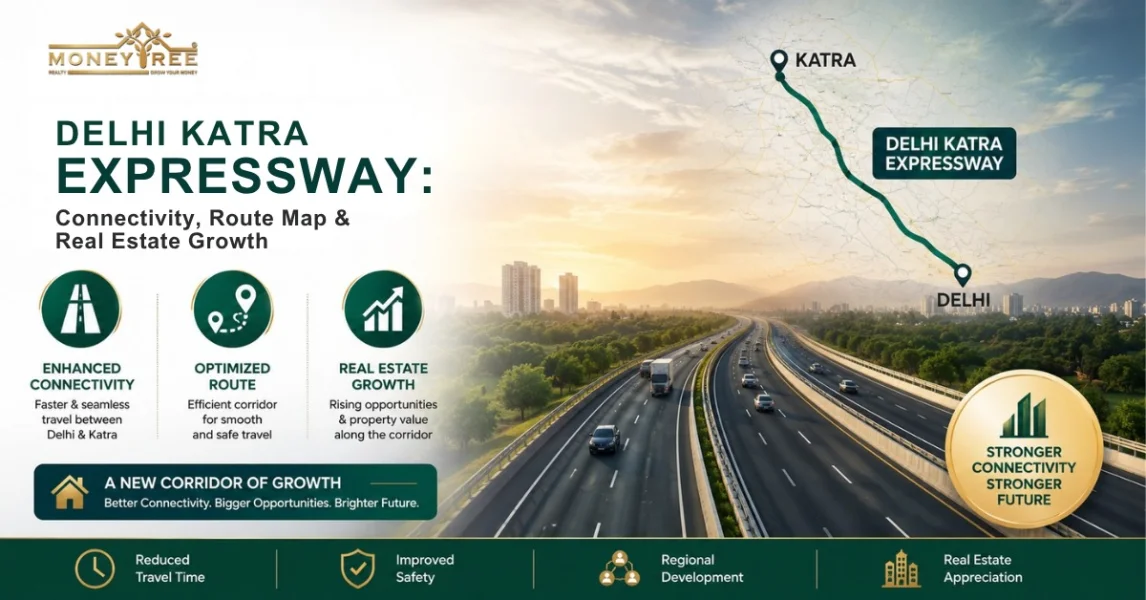
Infrastructure development is critical for connectivity and the growth of the real estate sector in North India. Among the several highway projects in this region is the Delhi Amritsar Katra Expressway, which goes by the name of the Delhi Katra Expressway. The expressway links Delhi to key destinations in the states of Haryana, Punjab, and Jammu & Kashmir, thus enhancing connectivity.
This is a roughly 670-km long access-controlled expressway that aims at improving connectivity between major urban centers and key destinations such as Katra. It will also contribute to a reduction in the travel time from Delhi to Katra. In July 2026, on the 10th, the government formally inaugurated a section of about 157.92 kilometres of the highway made up of Packages 1 through 5.
Other than better connectivity through roads, the expressway will certainly encourage various business activities, which will provide chances for further residential, commercial, and industrial development. The enhanced access would certainly increase the demand for lands in several upcoming regions.
Here in this guide, we will cover various aspects of the Delhi-Katra Expressway such as the route map, connectivity, current construction status, and the impact on real estate development.
Delhi Katra Expressway: Overview
The Delhi-Amritsar-Katra Expressway is an ambitious greenfield highway project that is currently under development in order to improve the road connectivity between the National Capital Region, Punjab, and Jammu & Kashmir; it should do so significantly faster.
The National Highway Authority of India is undertaking the project itself. This four-lane, access-controlled expressway is intended to connect to the existing highway network and major regional corridors. Following its completion along with the rest of the larger corridor, commuters and travelers (tourists, pilgrims, logistics operators and business travelers) between northern Indian states should find an added benefit in their connectivity.
Key Facts
| Features | Detail |
| The Project | Delhi- Katra Expressway |
| Rough Length Around | 670 K.M. |
| Development Agency | National Highways Authority of India (NHAI) |
| Structure of Development | Four-lane access-controlled corridor |
| Area Covered | Delhi-NCR, Haryana, Punjab, and Jammu & Kashmir |
| Main Places to be Connected | Delhi, Punjab, Amritsar, and Katra |
| Existing Status | The remaining 3 major components are operational, under progress, or in the final stage of works |
| The Purpose | To improve connectivity in the region. Improve logistics, tourism development, and the economy |
Total project length as generally advertised is in the ballpark of 670km. The actual time when specific sections will be open to use varies by package and location, so readers/buyers must get the latest info from NHAI before being set to use any access points or about any completion date.
Delhi Katra Expressway Route & Map
Delhi Katra Expressway route map will traverse a vast expanse of North India and aim to establish a link between Delhi, on one hand, and major towns and cities in Haryana, Punjab and Jammu & Kashmir on the other.
Starting Point and Ending Point
The greenfield expressway starts from a 54.5km section from Dhaula Kuan in the Delhi region until the Junction with H-2 at near Panipat, following the greenfield route from Haryana toward Punjab after which the expressway will pass from Punjab toward the Jammu and Kashmir where it terminates near Katra as a route for a quicker alternative to long distance traveling and also aim to help out with more connecting pathways for city centres as well as rising urban cities.
Major Cities and Districts Along the Route
The expressway corridor traverses multiple districts and urban centers in the region.
Delhi-NCR and Haryana
The southern end of the road is tied into the Delhi-NCR road network, and also connects into the existing expressway/highway network in Haryana. Key ties-in include the Western Peripheral Expressway and other expressways.
Punjab
Several key towns/districts in Punjab will lie either on or close to the path, including places like the surroundings of Patiala, Malerkotla, Ludhiana and Gurdaspur. A sideline is proposed to connect to Amritsar.
Jammu & Kashmir
The northern side leads to Jammu and Katra, which enhances the overall connectivity in the region and road access to tourism and pilgrimage sites. As of June 2026, officials are working towards completing 143 km of the Jammu & Kashmir stretch by the end of August 2027.
Key Interchanges and Connecting Highways
Connectivity with established highways is another important feature of this project. The corridor will be interconnected with some of the most significant roads:
This would benefit travellers, as they may access a variety of cities and regions beyond travelling on existing major roads, which usually involve congested routes.
Delhi Katra Expressway Connectivity
Delhi-NCR Connectivity
It may be the most important feature of the Expressway from the perspective of Delhi-NCR because the expressway integrates into an existing expressway and National Highway network within NCR.
The Western Peripheral Expressway at the junction gives a pathway to travelers in Gurugram and Sonipat and other places within NCR access to the corridor to head north without making their journey pass through the heart of Delhi. The enhanced network further aids access northwards and benefits goods & movement to/from NCR.
Punjab and Jammu Connectivity
The expressway will promote transit between both states, enhancing connectivity to vital commercial and holy sites. The corridor can help the following:
The government has shared that travel time will significantly come down once these sections start functioning. The Prime Minister had virtually dedicated 157.92 km of the Haryana section in July 2026,with the government claiming that when the entire concerned corridor is functional, it will likely take four hours to travel between Delhi and Katra.
Connectivity to Major Highways, Airports and Cities
Being an addition and not an independent development, the highway connects to several existing roadways, and the advantage of Delhi Katra Expressway connectivity can be established. With access through connecting highways, the corridor can connect to the points further located at:
Delhi, Gurugram and adjoining NCR Haryana Cities, Patiala and Punjab cities, Amritsar, Ludhiana, Gurdaspur, Jammu and Katra, etc.
The general connectivity via road enables people from the surrounding region to visit the airport and commercial hubs, etc.
Delhi Katra Expressway Construction & Current Status
The 667 km long Delhi-Amritsar-Katra Expressway is partially open for use, as its first 158 km have already been constructed in the state of Haryana. The rest of the km is currently under construction due to the issue of acquiring the land.
Construction Progress
The latest development regarding Delhi Katra Expressway in terms of construction has been: 157.92 km covering Packages 1 to 5 were dedicated to the nation in July 2026. The major chunk of this expressway falls in Haryana.
In July 2026, tender information as published by the Government in relation to Haryana and Punjab can suggest that there are ongoing works on the other portions.
Expected Completion Timeline
There is no overall completion date that covers all sections of the corridor; for instance, as of June 2026, the Jammu & Kashmir section of the 143 km corridor had an expected completion timeline of August 2027. Elsewhere in Punjab, ongoing tenders & construction work signal that some parts of the project will continue for some time.
Potential buyers should not take it to mean that the whole of the Delhi-Katra corridor is complete.
Major Development Phases
The project's various packages have advanced at differing paces, in view of issues like land acquisition and clearances, and local implementation hurdles.
How Delhi Katra Expressway Will Impact Travel Time
The Delhi Katra Expressway is projected to speed up and provide greater ease in transportation between Delhi-NCR, Punjab and Jammu & Kashmir.
Delhi to Jammu/Katra Connectivity
Once the required stretches open, it's expected that the distance from Delhi to Katra will be covered in approximately 6 hours, thus greatly facilitating access to Jammu and Katra.
Benefits for Commuters, Tourists and Businesses
Please note that actual travel duration will also be dependent upon traffic conditions, road status and the progress of road operationalization.
Delhi Katra Expressway & Real Estate Growth
Better infrastructure can also affect property through decreased travel times; higher accessibility and generation of commercial activity associated with suitably placed transport nodes.
Roading alone will not guarantee a property's growth, but the best opportunities are generally where added road access is accompanied by a combination of: existing urban structures, commercial and employment uses, and a development plan.
How Improved Connectivity Can Influence Property Demand
There are several places that have the possibility of being nearer to Delhi-NCR, Punjab and Jammu & Kashmir through the Delhi-Katra Expressway Connectivity.
Good connectivity can slowly improve the accessibility and appeal of these places as well for buyers and other commercial purposes. But there could be a certain advantage enjoyed by those places which are in proximity to an interchange as compared to the others which are close to the expressway.
There are certain aspects like approach road, connectivity to nearby towns and proximity to the nearest interchange that need to be taken into account by the buyers.
Real estate development is always influenced by infrastructure. Certain places along the corridor have also been seen to show a good rise in prices over the last few years. According to the market data, some places which have shown good rise in prices in the last four years include Amritsar and Malerkotla. Price appreciation in the past cannot be a guarantee of price appreciation in the future.
The real potential of the places would largely depend upon certain factors such as interchange accessibility, existing infrastructure, employment opportunities, population growth and development.
Residential and Commercial Real Estate Opportunities
The expressway can lead to opportunities in various property categories.
Residential Real Estate
With better connectivity, demand is expected to rise for:
Higher demand for housing is expected where the expressway access is supplemented by good social infrastructure like schools, hospitals, shopping malls, and centers of work.
Commercial Opportunities
Commercial opportunities might include:
Where they serve the needs of freight and the needs of tourists and pilgrims and their travel.
Emerging Investment Corridors
Delhi Katra Expressway real estate can be divided across its various states, where investment prospects differ from other locations.
Haryana Corridor
The Haryana segment gets the advantage due to its proximity to Delhi-NCR and connections to nearby expressways. Investors can check areas near conventional road exchanges for residential as well as for long-run mechanical, distribution business activities.
Punjab Corridor
The greater corridor across Punjab already hosts numerous conventional towns and industrial centers with enhanced accessibility of towns like Amritsar, Malerkota, and interconnected neighborhood markets, yet the venture period of activities depends upon specific tasks and bundles.
Jammu & Kashmir Corridor
The northern area can encourage the foundation of travel & hospitality and additionally different kinds of business activities in proximity to the towns of Jammu and Katra. Yet, certain parts of this section are as yet under execution, so financial specialists ought to proceed with the awareness of the same.
Best Locations for Real Estate Investment Near Delhi Katra Expressway
There is no universal destination for real estate investments. It all depends on many factors, including financial resources, the duration of the investment, the kind of property being bought, connectivity and growth potential. But if we talk about upcoming growth areas near Delhi Katra Expressway below you can see the best localities.
Upcoming Growth Areas
Factors to Consider Before Investing
Here’s how to tell if a major highway will be a neighbor or a burden. Don’t just trust the ‘5 km to the expressway’ marketing.
There is often little to do when you’re 2-kilos from the freeway but find yourself without proper access or just across a massive stretch of roadway. If there’s a lot of real estate with proper access to, say, an on-ramp just a few kilos’ away.
The factors you should be seeking are schools, hospitals, retail facilities, public transport, business and industrial employment, and a stable residential environment.
Do not decide on investment on the proposed closing period alone, and expect land and construction challenges may alter timeframes.
Compare new housing prices with the established prices and judge if the house costs at your location currently include infrastructure costs.
If purchasing a plot, house, or office space, examine all title deeds and permits before your transaction.
Delhi Katra Expressway: Economic and Infrastructure Impact
Beyond travel time reduction other impacts while shortening travel times, the route may also facilitate more economic activities through better connectivity along the corridor:
Industrial and Commercial Development
The accelerated movement of goods may make designated areas along the route ideal for logistics and warehousing or industrial purposes. Increased connectivity from manufacturing bases to consumption markets will also result in greater efficiency in supply chains.
Employment and Local Economic Growth
New industrial and commercial activities may drive job creation in the areas near the major transport corridor. This could over time spur local demand forhousing, retail,and various other goods and services.
Tourists and Logistics Potential
The corridor interfaces with a number of places with touristic, pilgrimage and commercial connotations, and improved road connectivity would also aid the development of these enterprises besides having a favorable impact on goods and logistics business.
Improved connectivity for tourism, especially to Katra, J&K, would aid a substantial impetus to hotels and hospitality as the sections of this improvement become operational, it is learnt.
Things to Consider Before Investing Near the Expressway
An infrastructure driven investment can look promising but there are several risks involved. Proper due diligence is to be done prior to purchase by a buyer.
Connectivity and Accessibility
Verify actual distance of the property to the nearest functional interchange. Also verify the access road quality and legality to the property.
RERA & Land Title Checks
In the case of RERA applicable residential/commercial projects, verify the RERA registration with the respective state authority. For land purchases, the land title, ownership, conversion status, land use and all possible development permissions need to be obtained.
Development Timelines and Future Infrastructure
The on-ground situation on construction must be verified rather than being swayed by advertisements or by what is said. Delays are evident in some portions of the Delhi-Amritsar-Katra corridor, with difficulties including land acquisition, farmer agitations, and shifting of services/clearances being cited as issues across Punjab in July 2026.
Conclusion: Delhi Katra Expressway & Future Real Estate Growth
The Delhi-Katra Expressway project is set to become a vital transportation backbone in Northern India connecting Delhi-NCR to Haryana, Punjab, and J&K. Given its capacity to reduce travel time, boost logistic operations, foster tourism, and spur commercial growth, it has the potential to offer several real estate opportunities along its wide corridor. But as for the real estate investors,connectivity should only be taken as one of the potential triggers, not as a solid assurance.
Instead, thorough research on actual access to interchanges, available infrastructure, current development stages, price of properties, government’s consent and long-term demand may give promising leads.
Once further phases are done, a view of the Delhi-Katra Expressway route map and its development around it will gain clarity. Investors will have to remain updated with the official announcements of the project to evaluate property on this route effectively.
If you think that your property search will be better situated with real estate investment trends in and around an developing infrastructure project, then let Moneytree Realty, India’s most trusted Real estate Advisor, help you assess the various properties, connectivity, project credibility and real estate potential for your future investment.
Disclaimer: The information contained in this article is for general awareness only. The status of the construction on the expressway, its routes and completion will vary over time. Real estate appreciation is not assured. All purchasers and investors shall check for proper approvals to the project, RERA registration if applicable, land title, ownership rights, infrastructure, etc, independently.
Frequently Asked Questions